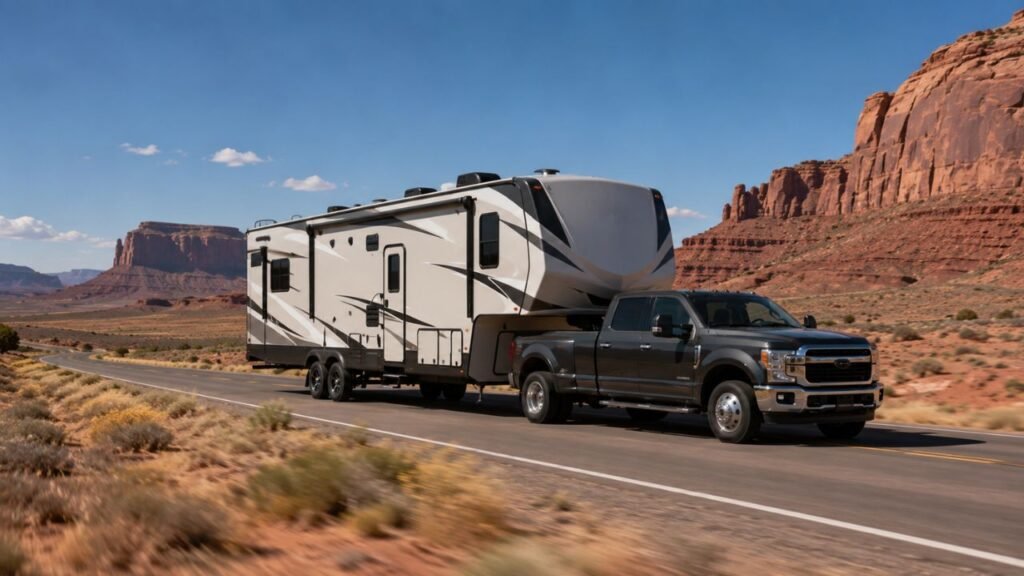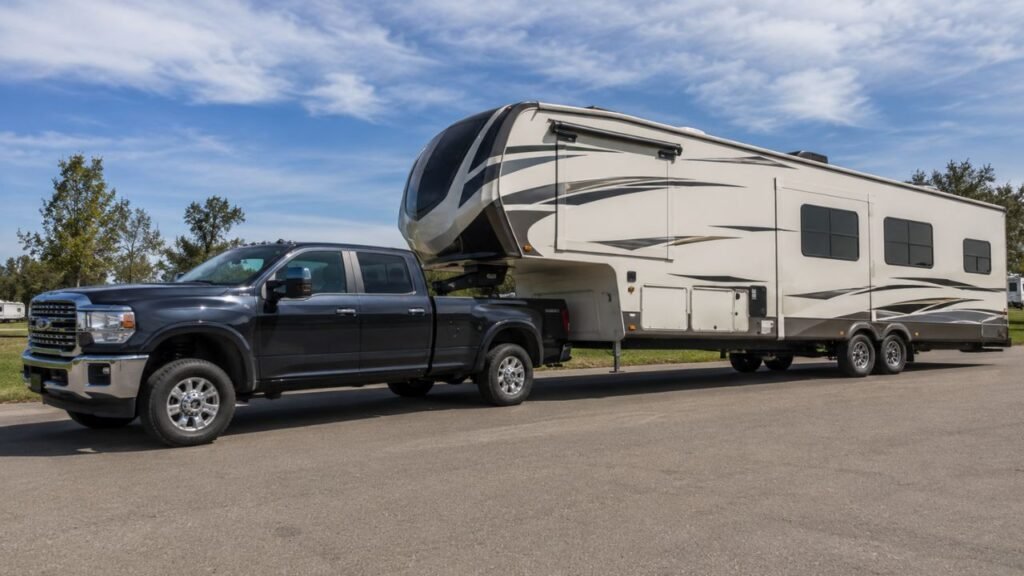
Your fifth wheel usually tows nose-high because the hitching point sits too high. A tall truck bed, raised hitch, low pin box, suspension modifications, or insufficient trailer height can create this mismatch.
I will help you identify the exact cause and correct it safely. We will also cover measurements, bed clearance, axle loading, and suspension adjustments.
Key Takeaways
- Measure the trailer while loaded and connected to your truck.
- A taller truck bed commonly causes fifth-wheel height problems.
- Lowering the hitch may reduce valuable truck-bed clearance.
- Moving the pin box upward can lower the trailer’s front.
- Airbag overinflation may make nose-high towing noticeably worse.
- Worn trailer suspension can also change the towing angle.
- Significant nose-high towing may create uneven axle loading.
- Six inches of bed clearance is a common starting guideline.
- Always follow the requirements for your specific towing equipment.
- Weighing each trailer axle provides the most reliable diagnosis.
Quick Diagnosis Table
The table below can help narrow down the likely cause. Start with the change that happened before you noticed the problem.
| What You Notice | Likely Cause | How to Confirm It | Possible Correction |
| The problem started after changing trucks | The new truck bed sits higher | Compare both trucks’ loaded bed heights | Lower the hitch or raise the trailer |
| The trailer became nose-high after hitch installation | The hitch head is mounted too high | Check the available adjustment holes | Lower the hitch within approved settings |
| The hitch is already at its lowest setting | The trailer sits too low for the truck | Measure frame and suspension height | Consider an approved trailer lift |
| The truck has a leveling kit | Front or rear ride height was changed | Compare factory and current suspension height | Correct the truck height or raise the trailer |
| Airbags keep the truck unusually high | Air pressure is excessive | Reduce pressure and remeasure | Use only enough pressure for load support |
| The trailer previously towed level | Suspension parts may be worn | Inspect springs, shackles, and equalizers | Repair worn components |
| Rear tires run hotter than front tires | Axle loading may be uneven | Weigh each axle separately | Level the trailer and inspect alignment |
| Bed clearance becomes too small when leveling | Truck and trailer heights are incompatible | Measure clearance around the entire bed | Raise the trailer through an approved method |
How Do I Know My Fifth Wheel Is Towing Nose-High?
A trailer can appear uneven because of decals, rooflines, or body panels. Confirm the condition by measuring the main frame on level ground.
Common signs include:
- The front frame measurement is higher than the rear measurement.
- The trailer slopes downward noticeably toward its rear bumper.
- Rear stabilizers have less clearance than they had previously.
- The rear trailer tires appear more compressed than the front tires.
- Rear tires run hotter during similar driving conditions.
- The trailer produces more chucking or bouncing than usual.
- The truck has generous bed clearance despite the raised trailer nose.
- The problem started after installing a new hitch or truck.
- One trailer axle carries more weight than the other axle.
- Rear plumbing or stabilizer components scrape on steep driveways.
Do not judge the towing angle using the trailer roof. Many fifth-wheel roofs have built-in slopes for water drainage.
Instead, measure from the ground to a straight frame section. Use matching points near the front and rear of the trailer.
What Causes a Fifth Wheel to Tow Nose-High?
Several different problems can create the same visible towing angle. Identifying the actual cause prevents unnecessary and potentially unsafe modifications.
The Truck Bed and Hitch Platform Are Too Tall
Modern heavy-duty trucks often sit considerably higher than older models. Four-wheel-drive packages, taller tires, and increased ground clearance contribute to this difference.
Your truck may also have taller bed rails than expected. This creates another problem because the trailer overhang must clear those rails.
A fifth wheel designed around an older truck may not match newer bed heights. The trailer can then sit nose-high even with correct hitch installation.
Puck-system adapters may also raise the hitch head. Some adapter systems add several inches between the truck bed and hitch plate.
The Fifth-Wheel Hitch Head Is Set Too High
Most fifth-wheel hitches provide several vertical adjustment positions. Installers sometimes choose a high setting to maximize truck-bed clearance.
That setting may leave the trailer’s front too high. It may also have been appropriate for the hitch’s previous truck.
Inspect the hitch legs or mounting brackets carefully. You may discover unused lower adjustment holes.
Never move hitch bolts into unapproved holes. Use only the positions described in the hitch manufacturer’s instructions.
The Pin Box Is Positioned Too Low
The pin box usually attaches to mounting wings beneath the trailer’s front frame. Several bolt positions may provide limited vertical adjustment.
Moving the pin box assembly upward brings the kingpin closer to the trailer frame. This generally lowers the trailer nose after connection.
However, raising the pin box also reduces truck-bed clearance. Measure your available clearance before making this adjustment.
Pin boxes are extremely heavy and awkward to support. Use proper lifting equipment or ask an experienced technician for help.
The Truck Has Been Lifted
Suspension lifts and leveling kits can create a serious height mismatch. Even a modest lift may move the hitch several inches upward.
Larger tires raise the hitching point further. Half of the added tire diameter increases the truck’s effective ride height.
A lifted truck may still handle its pin weight properly. However, the connected trailer may remain noticeably nose-high.
Removing or changing suspension modifications may be more practical than modifying the trailer. This depends on the truck’s intended use and current components.
Airbags Are Holding the Truck Too High
Airbags help support pin weight and reduce excessive rear suspension sag. They should not raise the loaded truck beyond an appropriate ride height.
Some owners add too much air because they want perfection. They try making the truck look completely unloaded while towing.
That extra pressure can raise the hitch and worsen nose-high towing. It may also create a harsher ride and additional hitch shock.
Use only enough pressure to maintain proper suspension clearance and truck attitude. Follow the airbag and truck manufacturer’s guidance.
The Trailer Does Not Have Enough Ride Height
Sometimes the truck cannot be lowered without losing bed clearance. In that situation, the trailer itself may need additional suspension height.
This problem is common with older fifth wheels and newer four-wheel-drive trucks. The truck and trailer were designed around different height standards.
Possible contributing factors include:
- Low suspension hangers
- Small trailer tires
- Underslung leaf-spring axles
- Low-profile suspension systems
- Limited frame-to-axle clearance
- Minimal factory suspension adjustability
Do not assume every trailer can safely accept a lift. Frame design, suspension type, and overall height must be reviewed first.
The Trailer Suspension Is Worn or Sagging
A fifth wheel that previously towed level may have weakened suspension components. Leaf springs gradually flatten after carrying heavy loads for years.
Worn equalizers and bushings can also reduce ride height. Broken spring leaves may cause an obvious drop on one side.
Check for:
- Flattened or reversed leaf springs
- Cracked spring leaves
- Worn shackle holes
- Loose or damaged U-bolts
- Bent equalizers
- Damaged suspension hangers
- Collapsed rubber suspension components
- Uneven side-to-side trailer height
Repair worn suspension before installing lift components. A lift should not hide damaged or overloaded running gear.
The Trailer Is Loaded Differently
Water, batteries, generators, propane, and rear storage affect suspension compression. A major loading change may alter the trailer’s towing attitude.
However, cargo placement should not become your main leveling method. Moving weight rearward may reduce pin weight and create handling concerns.
Load the trailer according to its ratings and storage design. Correct major height problems through proper mechanical adjustments.
How Nose-High Is Too Nose-High?
There is no single height difference that applies to every fifth wheel. Suspension design, trailer length, axle spacing, and loading all influence the outcome.
The goal is keeping the trailer frame close to level while loaded. A small difference may not create a measurable axle imbalance.
A larger difference deserves immediate attention, especially when you notice:
- Uneven axle weights
- Unusual tire temperatures
- Rapid tire wear
- Reduced rear ground clearance
- Increased bouncing or chucking
- Poor braking behavior
- Trailer contact with the truck bed
Measure the actual height difference instead of estimating visually. Then compare axle weights and available clearances.
A trailer sitting one inch high across a long frame may be minor. A shorter trailer with the same height difference has a steeper angle.
The safest judgment combines frame measurements, scale weights, tire condition, and handling behavior.
Why Is Nose-High Fifth-Wheel Towing a Problem?
A slightly raised nose does not guarantee immediate damage. However, a significant angle can affect loading, clearance, and suspension performance.
Uneven Trailer Axle and Tire Loading
A nose-high position can place more load toward the trailer’s rear. The exact change depends heavily on the suspension system.
Equalized leaf-spring suspensions attempt to share weight between both axles. They cannot always compensate perfectly for a substantial frame angle.
Independent torsion axles may react differently. The lower end of the trailer can carry noticeably more weight.
Uneven loading can lead to:
- Excess tire temperature
- Accelerated tread wear
- Reduced tire load margin
- Additional bearing stress
- Uneven brake performance
- Premature suspension wear
The only reliable confirmation is weighing each trailer axle separately. Individual wheel-position weights provide even better information.
Reduced Rear Ground Clearance
Raising the trailer’s front naturally lowers its rear. This reduces clearance under components near the back.
Possible contact points include:
- Rear stabilizer jacks
- Leveling system components
- Sewer pipes
- Hitch receivers
- Spare tire carriers
- Bumpers
- Underbelly panels
Steep fuel station entrances can cause sudden contact. Campsite transitions and sloped driveways create similar risks.
Poorer Ride and Handling
A nose-high trailer may respond differently during braking and lane changes. The effect depends on the severity and axle loading.
You may notice:
- Increased chucking
- More porpoising
- Excessive bouncing
- Slower recovery after bumps
- Less predictable braking
- Unstable tracking
- Increased tire movement
Nose-high towing does not always cause sway by itself. However, it can contribute to an already unstable towing setup.
Increased Suspension and Frame Stress
Uneven axle loading can increase repeated stress on suspension mounting points. Rough roads make these forces even stronger.
Closely inspect:
- Spring hangers
- Equalizer brackets
- Shackles
- U-bolts
- Axle mounting points
- Frame welds
- Pin box mounting areas
Cracks, elongated holes, and rust trails require professional inspection. These signs often indicate movement between structural components.
Truck-Bed Contact During Articulation
Lowering the hitch may improve the trailer angle but reduce clearance. This creates another serious towing hazard.
The trailer overhang can contact the truck-bed rails during:
- Sharp driveway transitions
- Uneven campground roads
- Off-camber turns
- Deep drainage dips
- Twisting entrances
- Steep uphill approaches
Clearance on flat pavement does not guarantee clearance during articulation. Check all corners around the truck bed.
How to Measure a Nose-High Fifth Wheel Correctly
Accurate measurements prevent you from correcting the wrong problem. Complete these steps with the trailer loaded for normal travel.
1. Load the Truck and Trailer Normally
Include passengers, fuel, propane, batteries, camping equipment, and usual water levels. Empty measurements may change considerably after loading.
Place cargo where it normally travels. Do not create a temporary load arrangement for testing.
2. Park on Firm, Level Ground
Use a flat parking lot, shop floor, or certified scale area. Avoid gravel surfaces with deep tire depressions.
Confirm that both truck and trailer tires share the same surface. A small ground slope can distort your measurements.
3. Connect the Trailer Completely
Hitch the trailer and retract the landing gear fully. Allow the truck and trailer suspensions to settle naturally.
Drive forward several feet before stopping again. This can remove suspension binding from the initial connection.
4. Check Tire Pressures
Incorrect pressure changes tire height and load behavior. Set pressures according to your trailer’s verified weight requirements.
Inspect the truck tires as well. A soft rear truck tire can change hitch height slightly.
5. Measure the Trailer Frame
Choose a straight section of the main frame. Measure near the front and rear using matching reference points.
Measure vertically from the ground to the bottom of the frame. Record both measurements clearly.
Avoid measuring:
- Decorative skirting
- Body trim
- Storage doors
- Roof edges
- Fiberglass panels
- Uneven underbelly material
Subtract the rear measurement from the front measurement. The difference shows how high the nose sits.
6. Measure Truck-Bed Clearance
Measure from the truck-bed rail to the trailer overhang. Check more than one location because overhang shapes vary.
Measure at:
- Both front corners
- Both rear corners
- The bed sides
- The tailgate area
- Any raised bed accessories
Record the smallest measurement. That number represents your available flat-ground clearance.
7. Measure Rear Ground Clearance
Find the lowest fixed component near the trailer’s rear. Measure its distance from the ground.
Consider how that clearance changes on steep transitions. A long rear overhang increases the chance of scraping.
8. Weigh the Truck and Trailer
A certified scale can reveal problems that measurements cannot show. Ideally, record the following weights:
- Truck steer axle
- Truck drive axle
- Front trailer axle
- Rear trailer axle
- Total trailer axle weight
- Combined vehicle weight
Many public scales report both trailer axles as one group. A specialist scale may provide separate axle or wheel weights.
Compare every result with the applicable ratings. Never rely only on the combined total.
How Much Fifth-Wheel Bed Rail Clearance Do I Need?
Approximately six inches is a common minimum starting point on level ground. However, it is not a universal requirement for every setup.
Some trucks and trailers need additional clearance because they travel over uneven ground. Long overhangs and high bed rails increase articulation concerns.
Your specific hitch, pin box, truck, and trailer instructions take priority. Some equipment combinations may require seven inches or more.
Bed rail clearance differs from cab clearance.
Bed rail clearance protects the truck box during pitching and twisting. Cab clearance protects the truck cab during sharp turns.
A sliding hitch can improve cab clearance in a short-bed truck. It normally does not increase clearance above the bed rails.
Use the smallest measured clearance around the entire truck bed. Do not rely on one convenient measurement near the hitch.
How Do You Fix a Fifth Wheel That Tows Nose-High?
Begin with the simplest approved adjustment and remeasure afterward. Avoid structural modifications until basic settings have been checked carefully.
Lower the Fifth-Wheel Hitch
Lowering the hitch head is often the easiest correction. This works only when adequate truck-bed clearance remains.
Use this process:
- Read the hitch installation instructions.
- Support the hitch head securely.
- Identify approved lower mounting holes.
- Move both sides equally.
- Reinstall the correct hardware.
- Torque every bolt as specified.
- Reconnect the trailer.
- Remeasure frame angle and bed clearance.
Do not lower one hitch side more than the other. The hitch plate must remain properly aligned.
After adjustment, inspect cab clearance during turns. Also confirm tailgate clearance during connection and disconnection.
Move the Pin Box Upward
Moving the pin box upward can lower the trailer’s connected front. This adjustment may provide one or two useful inches.
Support the pin box before loosening anything. Its weight can cause severe injury or component damage.
Use only approved mounting holes and original-grade hardware. Tighten all bolts using the proper sequence and torque.
Afterward, inspect:
- Bed rail clearance
- Pin box wing clearance
- Electrical cable routing
- Breakaway cable movement
- Hitch plate alignment
- Pin box bolt engagement
Never drill extra holes without written approval. Pin box wings are structural frame components.
Reduce Unnecessary Hitch Adapter Height
Some rail or puck adapters add considerable stack height. A lower-profile compatible system may improve the trailer angle.
Do not remove required adapters without an approved replacement. Every connection component must match both truck and hitch systems.
Check whether your hitch can mount directly into the truck’s puck system. A direct-mount version may sit lower than an adapter-mounted hitch.
Correct Airbag Pressure
Reduce excessive air pressure before making permanent trailer modifications. Then reconnect and measure the towing angle again.
Airbags should:
- Prevent bottoming out
- Maintain suspension clearance
- Improve loaded stability
- Support appropriate truck attitude
They should not lift the truck excessively above its loaded factory position.
Keep the minimum pressure required by the airbag manufacturer. Never operate the system completely empty when minimum pressure is required.
Repair Worn Trailer Suspension
Restore the trailer’s intended ride height before installing a lift. Worn components can make the trailer sit lower than designed.
Replace damaged or heavily worn:
- Leaf springs
- Shackles
- Bushings
- Equalizers
- U-bolts
- Hangers
- Suspension bolts
- Rubber shear components
Replace related components in matched pairs when appropriate. Mixing old and new parts may create uneven ride height.
Have the axle alignment checked after major suspension repairs. Incorrect alignment can quickly damage expensive trailer tires.
Install a Manufacturer-Approved Trailer Lift
A trailer lift may be necessary when the hitch cannot go lower. It can also preserve bed clearance while leveling the trailer.
Possible approved methods include:
- Suspension lift brackets
- Taller hanger systems
- Torsion-axle lift kits
- Factory adjustment holes
- Approved subframe installations
- Independent suspension adjustments
Raising a fifth wheel affects more than the frame angle. It may also change:
- Entry step height
- Stabilizer reach
- Leveling jack travel
- Sewer connection height
- Overall trailer height
- Center of gravity
- Wind sensitivity
- Plumbing clearance
Measure your new total height before traveling. Remember to include rooftop air conditioners and antennas.
Consider an Axle Over-Under Conversion
Some leaf-spring trailers have axles positioned above the springs. An approved over-under conversion moves the axle below the spring pack.
People often call this an axle flip. The axle itself should not simply be rotated upside down.
New spring seats must be installed in the correct position. Brake wiring, shocks, and tire clearance may also need modification.
This method does not apply to:
- Torsion axles
- Independent suspension systems
- Incompatible axle tubes
- Trailers lacking sufficient frame strength
Have the conversion completed by a qualified suspension technician. Poor installation can cause axle movement or alignment failure.
Reconsider the Truck and Trailer Combination
Some truck and trailer combinations cannot achieve both requirements safely. They may remain nose-high unless bed clearance becomes inadequate.
Possible solutions include:
- Returning the truck to factory ride height
- Using approved smaller truck tires
- Installing a lower-profile compatible hitch
- Choosing a different truck configuration
- Upgrading the trailer suspension professionally
- Using a trailer designed for taller trucks
Do not sacrifice truck-bed clearance merely to achieve a perfect visual angle. Both requirements must be satisfied together.
Which Adjustment Should You Make First?
Follow a logical order so you avoid expensive unnecessary modifications.
- Confirm the trailer is loaded normally before measuring.
- Check whether airbags are holding the truck excessively high.
- Inspect the hitch for lower approved mounting positions.
- Check whether the pin box can move upward safely.
- Inspect the trailer suspension for worn or damaged components.
- Repair suspension damage before installing lift equipment.
- Raise the trailer only when front adjustments are exhausted.
- Reweigh the axles after completing major adjustments.
- Recheck truck-bed clearance after every height change.
- Seek professional help when safe clearance remains impossible.
Make one adjustment at a time whenever possible. This helps you understand which change produced the improvement.
What Should You Not Do?
Quick shortcuts can create larger safety problems than the original towing angle.
- Do not lower the hitch without checking truck-bed clearance.
- Do not overinflate airbags to keep the truck perfectly high.
- Do not move bolts into unapproved mounting holes.
- Do not drill the pin box wings yourself.
- Do not weld frame components without written approval.
- Do not move heavy cargo rearward merely for leveling.
- Do not exceed truck, hitch, axle, tire, or trailer ratings.
- Do not install larger tires without checking wheel-well clearance.
- Do not copy another owner’s suspension modification blindly.
- Do not assume every axle supports over-under conversion.
- Do not ignore abnormal tire heat after adjustment.
- Do not keep towing with damaged suspension components.
A visually level trailer can still be overloaded. Always verify actual weights after meaningful modifications.
When Should You Stop Towing and Call a Professional?
Some symptoms indicate more than a simple height adjustment problem. Stop towing when continued travel could cause structural or tire failure.
Seek professional help when:
- One trailer axle exceeds its rated capacity.
- A trailer tire becomes unusually hot.
- The trailer contacts the truck bed.
- Bed clearance falls below equipment requirements.
- A spring leaf is cracked or broken.
- Spring hangers show cracks or movement.
- Pin box holes appear stretched or damaged.
- Frame cracks appear near suspension mounts.
- The trailer leans sideways while connected.
- Rear stabilizers repeatedly strike the road.
- The hitch cannot be lowered safely.
- The trailer needs welding or structural modification.
A qualified RV frame shop can inspect the entire system. A suspension specialist can also measure alignment and axle loading.
How to Prevent Height Problems After Changing Trucks
Towing capacity alone does not guarantee fifth-wheel compatibility. Bed height and hitch geometry matter just as much.
Before buying another truck, compare:
- Loaded truck bed rail height
- Expected hitch plate height
- Trailer kingpin height while level
- Trailer overhang height
- Required bed rail clearance
- Cab-to-trailer turning clearance
- Truck rear axle rating
- Truck payload rating
- Hitch height adjustment range
- Trailer suspension adjustment range
Measure the trailer while it stands level on firm ground. Then compare the kingpin height with the truck’s expected loaded hitch height.
Allow for truck suspension compression under pin weight. Heavy-duty trucks may sag less than expected.
Also consider factory packages carefully. Larger tires and off-road suspensions can create extra height without increasing useful towing compatibility.
Final Verdict
A fifth wheel usually tows nose-high because the hitch point sits too high. Tall truck beds, raised hitches, low pin boxes, airbags, and suspension differences are common causes.
Start by measuring the loaded trailer frame and truck-bed clearance. Then weigh the axles before choosing a correction.
Lower the hitch or raise the pin box when clearance permits. Repair worn suspension parts before considering lift equipment.
When those adjustments are not enough, use an approved trailer lift. The final setup should remain close to level without sacrificing axle ratings or truck-bed clearance.
Related FAQs
Can I Tow a Fifth Wheel Slightly Nose-High?
A slight difference may be acceptable when axle weights, tire temperatures, handling, and clearances remain normal. However, the trailer should still tow as close to level as reasonably possible.
Does Nose-High Towing Overload the Rear Trailer Axle?
It can place more weight on the rear axle, depending on suspension design. Weighing each trailer axle separately is the most reliable way to confirm unequal loading.
Should I Lower My Fifth-Wheel Hitch?
Lower the hitch only when approved adjustment holes are available. You must also maintain enough clearance between the trailer overhang and truck-bed rails.
Should I Raise or Lower the Pin Box?
Moving the pin box upward on its mounting wings generally lowers the trailer’s nose. This adjustment also reduces bed rail clearance, so measure carefully afterward.
Will Airbags Fix a Nose-High Fifth Wheel?
Airbags support the truck’s rear suspension but rarely correct a true height mismatch. Excessive air pressure may raise the hitch and worsen the problem.
Can Larger Trailer Tires Help Level My Fifth Wheel?
Larger tires may raise the trailer slightly, but clearance and load ratings matter. Check wheel wells, axle spacing, wheel capacity, and overall trailer height first.
Can I Flip My Fifth-Wheel Axles?
Some leaf-spring trailers support an approved over-under conversion. Torsion axles cannot use the same method, and the axle should not simply be turned upside down.
Is Six Inches of Bed Rail Clearance Enough?
Six inches is a common starting guideline on level ground. Your specific equipment may require more clearance for steep roads, uneven campsites, or greater articulation.
Should My Truck Sit Completely Level While Towing?
Your truck should remain within its intended loaded ride position. Trying to remove every amount of rear suspension compression can raise the hitch unnecessarily.
Do I Need to Weigh the Trailer After Adjusting It?
Yes, especially after changing suspension height or hitch position. Scale measurements confirm that all truck and trailer axles remain within their ratings.
Can Nose-High Towing Cause Tire Wear?
Yes, significant uneven axle loading can increase tire temperature and wear. Alignment problems, inflation errors, and overloaded axles can create similar symptoms.
Will a Sliding Hitch Fix Nose-High Towing?
A sliding hitch mainly improves cab clearance during sharp turns. It will not correct nose-high towing unless its installed height differs from your current hitch.
Can I Lower My Truck Instead of Raising the Trailer?
Possibly, especially when the truck has aftermarket lifts or oversized tires. Any change must preserve suspension travel, axle capacity, and tire clearance.
Why Did My Fifth Wheel Become Nose-High After Changing Trucks?
The replacement truck probably has a taller bed, larger tires, or less rear suspension sag. Its hitch platform may also sit higher than your previous truck’s hitch.
Should I Tow Before Fixing a Nose-High Fifth Wheel?
Avoid extended towing when the angle is significant or symptoms appear. Tire heat, poor handling, scraping components, or inadequate bed clearance require immediate correction.

David Marshall shares travel route insights, mileage planning tips, and road-tested advice. His writing helps travelers understand distance, timing, and equipment choices. Every article is built around clarity and real-world usefulness.