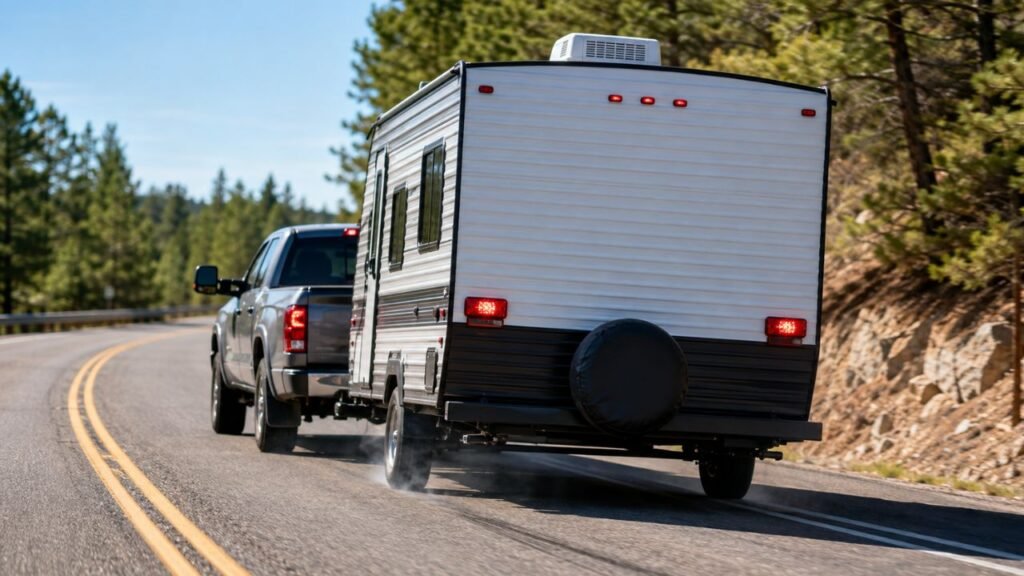
A trailer pulls to one side when braking because its wheels produce uneven braking force. Common causes include weak brake magnets, damaged wiring, uneven brake adjustment, contaminated brake shoes, sticking hydraulic components, tire problems, worn bearings, or axle misalignment.
In this guide, I will help you identify the likely cause. We will also cover safe testing steps and practical repair options.
Key Takeaways
- A trailer usually pulls toward the side producing stronger braking force.
- Electric brake problems often involve wiring, grounds, magnets, or adjustment.
- A leaking wheel seal can contaminate one brake assembly with grease.
- Hydraulic brakes may pull because of sticking calipers or wheel cylinders.
- Uneven tire pressure can make an existing brake imbalance feel worse.
- Hot hubs, wheel lockup, smoke, or grinding require immediate attention.
- Changing brake-controller gain may hide the problem without fixing it.
- Inspect both sides of each axle instead of repairing one wheel blindly.
Why Does a Trailer Pull Sideways During Braking?
Your trailer should produce nearly equal braking force on both sides. When one wheel brakes harder, the trailer begins rotating toward that wheel.
Think about a shopping cart with one wheel dragging. The cart naturally turns toward the wheel creating greater resistance. Your trailer reacts in a similar way during braking.
The problem can happen in two different ways. One brake may become too aggressive, or the opposite brake may become too weak.
For example, suppose the left brake works normally while the right brake barely engages. The stronger left brake may pull the trailer toward the left.
You might notice the trailer shifting behind your tow vehicle. You may also feel a sideways tug through the hitch.
Other warning signs can include:
- One wheel locking before the others
- The trailer stepping sideways during harder stops
- A pull only when using the manual controller
- Uneven brake-drum temperatures after driving
- One tire skidding while the others keep rolling
- The tow vehicle being pushed slightly off course
A slight movement on a heavily crowned road can sometimes occur. However, noticeable pulling during normal braking should always be investigated.
Trailer Brake Pull Diagnosis Table
Several different problems can create similar symptoms. This table can help you decide where to begin looking.
| Symptom | Most Likely Cause | First Inspection | Urgency |
| Pull occurs only when trailer brakes activate | Uneven electric brake output | Wiring, grounds, magnets, and adjustment | High |
| One wheel locks before the others | Brake adjusted too tightly | Brake adjustment and controller gain | High |
| Pull began after bearing service | Grease contamination or incorrect adjustment | Wheel seal, drum, shoes, and bearing preload | High |
| One brake drum stays noticeably cooler | Weak magnet or loose adjustment | Electrical supply and brake condition | High |
| One drum becomes extremely hot | Dragging brake or damaged bearing | Brake hardware, adjustment, and bearing | Immediate |
| Trailer drifts even without braking | Tire, loading, axle, or suspension issue | Tires, load distribution, and alignment | Moderate |
| Surge-brake trailer pulls sideways | Sticking caliper or wheel cylinder | Hydraulic components and brake fluid | High |
| Pull worsens with higher controller gain | Existing brake imbalance | Adjustment, magnets, wiring, and contamination | High |
| Pull changes after loading cargo | Uneven side-to-side loading | Cargo placement and tire loading | Moderate |
| Grinding accompanies the pull | Damaged brake or bearing components | Remove the hub or drum immediately | Immediate |
Brake temperature can provide useful clues. However, temperature alone cannot confirm the exact failed component.
A hot drum may indicate a dragging brake. It could also indicate an overtightened or damaged wheel bearing.
Common Causes in Electric Trailer Brakes
Electric trailer brakes depend on equal current and consistent mechanical movement. A problem at one wheel can quickly create uneven stopping force.
Corroded, Loose, or Broken Brake Wiring
Each electric brake magnet needs a reliable electrical supply. Damaged wiring can reduce the power reaching one brake assembly.
Trailer brake wiring often runs beneath the frame and across axles. These locations expose it to water, stones, vibration, road salt, and moving suspension parts.
Common wiring problems include:
- Corroded wire connectors
- Loose crimp terminals
- Pinched insulation
- Frayed wires near backing plates
- Broken axle crossover wires
- Undersized replacement wiring
- Connections hidden inside axle tubes
- Damaged trailer-plug terminals
A partially broken wire may still pass some current. However, it may not deliver enough power under braking load.
This can make one magnet weaker than the opposite magnet. The stronger side then slows faster and pulls the trailer sideways.
Start by inspecting every visible wire near the affected axle. Gently move each connection while looking for looseness or damaged insulation.
Electrical testing should be performed while the brakes are activated. A wire may show voltage without carrying enough current under load.
Poor Ground Connections
Electric brakes require both power and a dependable ground path. A poor ground creates resistance and reduces magnet performance.
Rust, paint, dirt, or loose hardware can weaken a frame ground. Corrosion can also develop inside a connector that appears normal outside.
Some trailers use the frame as part of the grounding path. Others run dedicated ground wires back toward the trailer plug.
A dedicated ground wire is generally easier to test. It also avoids relying entirely on rusty frame connections.
Inspect ground points for:
- Rust beneath terminals
- Loose mounting screws
- Paint between terminals and metal
- Green corrosion inside connectors
- Damaged wire strands
- Ground wires stretched by suspension movement
Clean the connection until bare metal becomes visible. Then tighten the terminal securely and protect it from moisture.
Do not assume the main trailer ground is the only concern. A branch ground near one brake can also fail independently.
Weak or Failed Brake Magnet
The brake magnet activates the shoes inside an electric drum brake. When energized, it contacts the rotating drum surface.
That movement pulls the actuating arm and spreads the brake shoes. A weak magnet cannot produce the same braking force as a healthy one.
Brake magnets can fail because of:
- Open electrical windings
- Shorted internal windings
- Worn magnet faces
- Damaged lead wires
- Excessive heat
- Uneven wear patterns
- Incorrect replacement parts
A magnet face should wear relatively evenly. Deep grooves or unusual angles may indicate poor contact with the drum.
Check the magnet wires where they pass through the backing plate. Repeated movement can damage insulation near that location.
A resistance test can help identify an open or shorted magnet. Current-draw testing can provide an even better comparison between brake assemblies.
Replacement magnets must match the brake size and manufacturer specifications. Mixing different magnet types can create inconsistent brake response.
Uneven Brake-Shoe Adjustment
One brake can engage earlier simply because its shoes sit closer. The opposite brake may need much more movement before making contact.
Manual-adjusting brakes require periodic adjustment as their linings wear. Self-adjusting brakes can also become uneven if their mechanisms stick.
Uneven adjustment can happen after:
- Bearing repacking
- Drum removal
- Brake replacement
- Incorrect initial setup
- Uneven shoe wear
- A seized star-wheel adjuster
- A broken self-adjusting cable
A tightly adjusted brake may grab early or drag continuously. A loosely adjusted brake may contribute very little stopping force.
Raise the trailer safely and rotate each wheel by hand. Compare the amount of brake drag between wheels on the same axle.
Follow the brake manufacturer’s adjustment procedure. Do not tighten one wheel based only on how another wheel feels.
Internal drum condition can also affect the final adjustment. A worn or out-of-round drum may create inconsistent contact.
Grease or Oil on the Brake Shoes
A failed wheel seal can allow bearing grease into the brake drum. Grease-coated brake shoes lose much of their normal friction.
The clean brake on the opposite side then works harder. This imbalance can cause a strong pull during braking.
Grease contamination may develop after:
- Overfilling a greaseable hub
- Installing the seal incorrectly
- Reusing a damaged seal
- Using the wrong seal size
- Excessive bearing play
- Pressurizing the hub too quickly
You may notice grease around the backing plate. However, contamination often remains hidden until the drum is removed.
Inside the drum, look for:
- Wet brake linings
- Grease streaks
- Shiny or darkened shoes
- Grease on the magnet
- Contamination around the inner bearing
Cleaning the drum may not restore contaminated brake shoes. Grease can soak deeply into the lining material.
Replacing the affected shoes or complete brake assembly is usually safer. The leaking seal and bearing condition must also be corrected.
Inspect the brake on the opposite side of that axle. Both sides should provide reasonably similar friction and response.
Worn, Cracked, or Glazed Brake Shoes
Brake shoes gradually become thinner during normal use. Uneven wear can make one wheel respond differently from another.
Glazed shoes have a smooth, shiny surface. They may develop after overheating, prolonged dragging, or repeated aggressive braking.
Glazed linings can produce weak or unpredictable friction. Cracked or separated linings may behave even more inconsistently.
When inspecting brake shoes, look for:
- Uneven lining thickness
- Cracks across the friction material
- Missing chunks
- Heat discoloration
- Smooth, polished surfaces
- Loose lining material
- Contamination from grease or fluid
Do not replace only one shoe within an assembly. Brake shoes are normally replaced as a matched set.
Both brakes on the same axle should also be inspected. A major difference in wear may point toward another underlying problem.
Broken or Sticking Brake Hardware
Electric drum brakes contain springs, adjusters, retainers, pivots, and actuating arms. Every component must move correctly.
Rust or broken hardware can prevent one brake from applying. It can also prevent the shoes from releasing after braking.
Possible hardware problems include:
- Broken return springs
- Seized star-wheel adjusters
- Bent actuating arms
- Rusted pivot points
- Loose shoe retainers
- Damaged backing plates
- Dislodged brake shoes
- Incorrectly installed springs
A broken spring can let one shoe remain against the drum. This creates heat, drag, and unpredictable braking.
A seized actuating arm can produce the opposite problem. The magnet may energize without properly expanding the shoes.
Replacing the complete backing-plate assembly can sometimes be practical. This provides new shoes, springs, magnets, and adjusters together.
Mismatched Brake Assemblies or Replacement Parts
Trailer brake assemblies should be compatible across the same axle. Mismatched parts can provide different braking force.
This sometimes occurs when only one damaged assembly gets replaced. The replacement may have a different magnet, shoe material, or design.
Potential mismatches include:
- Different brake diameters
- Different shoe widths
- Different magnet ratings
- Manual and self-adjusting assemblies
- Different friction materials
- New components opposite heavily worn parts
Matching the bolt pattern does not always guarantee identical performance. Confirm the complete brake specifications before installing replacement parts.
Common Causes in Hydraulic and Surge Trailer Brakes
Hydraulic trailer brakes use fluid pressure instead of electric magnets. Uneven fluid movement or sticking parts can make one wheel brake harder.
Sticking Brake Caliper
Disc-brake trailers use calipers to squeeze pads against each rotor. The caliper piston and sliding hardware must move freely.
Corroded slide pins can prevent the caliper from applying evenly. A seized piston can also keep one brake partially engaged.
Common signs include:
- One rotor becoming extremely hot
- A burning brake smell
- Rapid pad wear on one wheel
- Reduced fuel economy
- Pulling during braking
- Pulling even after releasing the brakes
Compare pad wear between both sides of the axle. One very thin pad often points toward a sticking component.
Never touch a suspected hot rotor or hub directly. Use caution because brake parts can cause serious burns.
Seized or Leaking Wheel Cylinder
Some hydraulic trailer systems use drum brakes with wheel cylinders. Fluid pressure pushes the cylinder pistons outward against the shoes.
A seized piston can prevent one shoe from applying correctly. A leaking cylinder can contaminate the brake lining with fluid.
Look for dampness near the bottom of the backing plate. Brake fluid may also appear inside the drum.
A leaking wheel cylinder requires immediate replacement. The contaminated brake shoes should also be replaced.
After repairs, the hydraulic system must be bled correctly. Remaining air can continue causing uneven braking.
Restricted or Damaged Brake Hose
Flexible brake hoses can deteriorate internally while appearing normal externally. A damaged internal layer may restrict fluid flow.
This can delay pressure reaching one brake. It may also trap pressure after the driver releases the brakes.
A trapped-pressure brake may remain partially applied. That wheel will often become hotter than the others.
Inspect hoses for:
- Cracks
- Bulges
- Kinks
- Abrasion
- Rusted fittings
- Wet connections
- Contact with suspension parts
An internally restricted hose usually needs replacement. Cleaning or straightening it will not restore reliable operation.
Air or Uneven Pressure in the Hydraulic System
Air compresses under hydraulic pressure. Brake fluid does not compress significantly during normal operation.
Air trapped near one wheel can delay or weaken that brake. The opposite wheel may then produce greater stopping force.
Air can enter through:
- Low brake-fluid levels
- Leaking fittings
- Damaged brake lines
- Component replacement
- Improper bleeding
- Worn actuator seals
Check the complete system for leaks before bleeding it. Otherwise, fresh air may enter again after servicing.
Use the correct brake fluid specified by the manufacturer. Mixing incompatible fluid types can damage seals and components.
Corroded Surge-Brake Linkage
Surge brakes use forward trailer movement to compress the actuator. Rust or damage can prevent that mechanism from moving smoothly.
A sticky actuator can cause harsh, delayed, or inconsistent braking. However, it often affects multiple wheels together.
When only one side pulls, inspect wheel-specific components first. These include calipers, cylinders, hoses, and contaminated friction surfaces.
The actuator should slide without severe binding. Its breakaway cable, master cylinder, and mechanical linkage also require inspection.
Tire, Wheel, and Bearing Problems That Can Cause Pulling
Not every braking pull begins inside the brake system. Tires and rotating components can change how the trailer tracks during deceleration.
Unequal Tire Pressure
An underinflated tire has greater sidewall flex and rolling resistance. It may also carry weight differently during braking.
Check every trailer tire when it is cold. Compare your readings with the manufacturer’s recommended cold pressure.
Do not reduce pressure simply to soften the ride. Trailer tires often require higher pressure than passenger-car tires.
Inspect valve stems for cracking or leakage. A slow leak may repeatedly create side-to-side pressure differences.
Unequal pressure may not be the only problem. However, it can magnify an existing brake imbalance.
Damaged or Unevenly Worn Tires
A damaged tire can steer or resist movement unpredictably. Internal belt separation may not always be obvious initially.
Look for:
- Sidewall bulges
- Wavy tread surfaces
- Uneven shoulder wear
- Flat spots
- Exposed cords
- Cracked sidewalls
- Different tire sizes
- Mismatched load ratings
Run your hand lightly across the tread when the tire is cool. High spots or waves can indicate internal damage.
Uneven tire wear can also reveal axle or suspension problems. Do not automatically blame the brake system alone.
Loose or Overheated Wheel Bearing
Wheel bearings support the hub and keep it rotating correctly. Excessive looseness allows the drum or rotor to move.
That movement can change brake contact and wheel alignment. It may also damage seals and spread grease onto the shoes.
An overtightened bearing creates excessive friction and heat. This drag can feel similar to an applied brake.
Possible bearing symptoms include:
- Growling or grinding sounds
- Excessive hub heat
- Side-to-side wheel movement
- Grease leakage
- Metallic debris in grease
- Uneven brake wear
Bearing adjustment must follow the hub manufacturer’s procedure. Guessing the spindle-nut tightness can damage the bearing.
Bent Wheel or Damaged Hub
A bent wheel may create unusual tire movement under load. A damaged hub can also produce excessive runout.
Runout means the drum, rotor, or wheel does not rotate evenly. This can create pulsating or inconsistent brake contact.
Check for visible wheel wobble while rotating the raised wheel. Any significant movement requires closer inspection.
Can Axle Alignment or Suspension Problems Cause Brake Pull?
Axle and suspension faults usually affect tracking during normal towing. Braking forces can make their symptoms much more noticeable.
Bent or Misaligned Trailer Axle
A bent axle can change the toe or camber angle. The tires may then try to travel in slightly different directions.
During braking, these conflicting forces can steer the trailer sideways. Uneven tire wear often appears before severe pulling develops.
Possible alignment clues include:
- Feathered tread wear
- Rapid wear on one tire edge
- Trailer dog-tracking
- Unequal wheel spacing
- Visible axle damage
- Pulling without brake application
Axle alignment requires accurate measurements. A trailer or suspension specialist should inspect suspected axle damage.
Worn Leaf-Spring or Equalizer Components
Multi-axle trailers rely on springs, shackles, bushings, and equalizers. Wear allows the axles to shift under changing loads.
During braking, loose suspension parts may move temporarily. This changes the wheel position and can create a sudden pull.
Inspect:
- Spring-eye bushings
- Shackle plates
- Equalizers
- Hanger welds
- Suspension bolts
- Leaf springs
- Wet bolts
- Mounting brackets
Elongated bolt holes are a serious concern. They can allow much more movement than normal bushing wear.
Loose Axle U-Bolts
U-bolts clamp each axle securely to its springs. Loose U-bolts may let the axle shift during braking.
A shifted axle can change alignment instantly. It can also damage spring seats and suspension hardware.
Check for polished metal, displaced spring plates, or uneven axle positions. These signs suggest movement between components.
Do not continue towing with a loose axle. The trailer needs proper support and immediate repair.
Uneven Trailer Loading
Heavy cargo on one side changes tire loading and available traction. The heavily loaded side may respond differently during braking.
Uneven loading can also change suspension height. This affects axle alignment and brake behavior under deceleration.
Place heavy cargo low and close to the trailer’s centerline. Secure everything so it cannot shift while traveling.
Confirm that no tire, wheel, or axle exceeds its rating. Overall trailer weight alone does not reveal side-to-side overloads.
How to Determine Which Trailer Brake Is Faulty
A systematic inspection prevents unnecessary parts replacement. Begin with easy external checks before removing drums or hydraulic components.
- Confirm exactly when the pull occurs: Note whether it happens while cruising, braking, or using manual control.
- Check tire pressures and tire condition: Inspect every tire cold and look for damage or unusual wear.
- Verify the trailer’s cargo distribution: Confirm heavy items have not shifted toward one side.
- Test the trailer brakes manually: Use low speed in a safe, open area.
- Inspect the trailer plug and main wiring: Look for corrosion, damaged terminals, and loose connections.
- Compare wiring at every brake assembly: Check both voltage and current while the brakes operate.
- Compare drum or rotor temperatures: Use an infrared thermometer after controlled braking.
- Raise and rotate each wheel safely: Listen for grinding and compare resistance between wheels.
- Check bearing looseness: Excessive wheel movement may indicate bearing or hub problems.
- Remove drums when external checks reveal nothing: Inspect shoes, magnets, adjusters, springs, drums, and seals.
- Inspect hydraulic components when applicable: Check calipers, cylinders, hoses, lines, and the actuator.
- Inspect suspension and axle mounting hardware: Look for loose U-bolts, worn bushings, or shifted axles.
Always support the trailer with appropriately rated jack stands. Never work beneath a trailer supported only by a jack.
Does the Trailer Pull Toward the Strong or Weak Brake?
A trailer usually pulls toward the side creating greater braking force. However, the direction can sometimes feel confusing from the tow vehicle.
Suppose the right brake receives weak electrical power. The stronger left brake may slow its wheel faster and pull the trailer left.
A dragging brake can also pull toward the affected side. That wheel already creates resistance before additional braking begins.
Road crown, hitch movement, and tow-vehicle steering can alter what you feel. Therefore, do not diagnose the failed side using direction alone.
Compare temperatures, brake adjustment, wiring readings, and internal condition. Those checks provide much more reliable evidence.
Can the Brake Controller Make a Trailer Pull Sideways?
A brake controller can make an existing imbalance feel more severe. Higher gain sends stronger braking commands to the trailer.
However, the controller normally powers the complete brake circuit together. It does not intentionally send more power to one side.
A one-sided pull more commonly indicates:
- Uneven brake adjustment
- Damaged branch wiring
- A weak brake magnet
- Contaminated brake shoes
- A sticking mechanical component
- Different brake assemblies
- A tire or bearing problem
Reducing gain may make the pull less noticeable. Unfortunately, it also reduces overall trailer braking performance.
Check the controller setup after repairing the underlying fault. Then perform controlled stops and adjust the gain correctly.
How to Fix a Trailer That Pulls When Braking
The correct repair depends on the failed system. Avoid replacing random parts before completing a careful inspection.
Repair Electrical Connections
- Replace frayed, pinched, or corroded wiring.
- Clean every frame ground to bare metal.
- Tighten loose terminals and mounting screws.
- Replace damaged trailer-plug connectors.
- Use properly sized brake wiring.
- Protect connectors from water and road debris.
- Route wires away from springs and moving axles.
- Compare loaded voltage at each brake.
- Repair hidden crossover wiring when necessary.
Secure repaired wiring with enough flexibility for suspension movement. Tight wiring can break when the axle moves.
Service or Replace Brake Magnets
Replace any magnet with damaged wires or excessive face wear. Confirm its specifications match the brake assembly.
Inspect the drum’s magnet-contact surface before installing the new magnet. Deep grooves can damage the replacement quickly.
When several magnets show similar age and wear, inspect them together. Matching condition across an axle supports balanced braking.
Adjust All Trailer Brakes Evenly
Adjust every brake using the manufacturer’s recommended procedure. Do not adjust only the wheel that appears suspicious.
Rotate each wheel while adjusting the star wheel. Aim for similar light resistance across comparable brake assemblies.
After adjustment, perform several controlled stops. Self-adjusting brakes may need proper brake applications before settling.
If one brake repeatedly loses adjustment, inspect its hardware. A broken adjuster or worn drum may be responsible.
Replace Contaminated or Damaged Brake Parts
A leaking wheel seal must be replaced before installing new brakes. Otherwise, contamination will return.
Replace grease-soaked shoes instead of relying entirely on cleaning. Inspect magnets, drums, bearings, and hardware at the same time.
If one assembly suffered severe overheating, inspect the opposite side. Both brakes should provide comparable friction and operation.
Repair Hydraulic Brake Components
- Replace leaking wheel cylinders.
- Service or replace sticking calipers.
- Replace restricted flexible hoses.
- Repair leaking steel brake lines.
- Replace contaminated pads or shoes.
- Bleed air from the hydraulic system.
- Check the actuator’s fluid level.
- Lubricate approved actuator pivot points.
- Test the breakaway mechanism.
Never reuse brake fluid drained from the system. Use fresh fluid matching the manufacturer’s required specification.
Correct Tire, Bearing, or Alignment Problems
Replace damaged or mismatched tires before testing the brakes again. Set every tire to the proper cold pressure.
Service loose, dry, or overheated bearings immediately. Replace damaged races and seals rather than repacking failed components.
Tighten suspension hardware using correct torque specifications. Replace elongated shackles, bushings, or damaged hangers.
Professional alignment may be necessary for bent or shifted axles. Brake adjustments cannot correct an axle-tracking problem.
Should Trailer Brakes Be Repaired in Axle Pairs?
Brake components on the same axle should provide similar performance. Large differences in age, wear, or design can create imbalance.
You do not always need to replace every component together. However, both sides must be inspected before choosing the repair.
Brake shoes or pads are commonly replaced in axle pairs. This maintains similar friction material and wear condition.
If one magnet fails because of physical wire damage, only that magnet may need replacement. Still, compare the remaining magnets carefully.
Complete brake assemblies can be cost-effective on older electric drum systems. They replace shoes, springs, adjusters, and magnets together.
Always follow the component manufacturer’s service guidance. Trailer size, brake design, and operating conditions can affect the recommendation.
Is It Safe to Tow a Trailer That Pulls When Braking?
A trailer that pulls noticeably during braking is not operating normally. It should be inspected before regular towing continues.
Uneven braking reduces directional control during emergency stops. It can also overload the working brakes and overheat nearby components.
Stop towing immediately when you notice:
- Smoke near a wheel
- A burning brake smell
- Severe sideways movement
- Repeated wheel lockup
- Brake-fluid leakage
- A very hot hub
- Grinding or scraping noises
- A loose wheel
- Shifted suspension parts
- Damaged axle hardware
Do not pour water onto a hot brake drum. Sudden cooling can damage components and create hot steam.
Reducing controller gain is not a complete repair. It may reduce the symptom while leaving the trailer under-braked.
How to Prevent Uneven Trailer Braking
Regular inspections help catch small differences before they become serious. Include the brakes in your normal towing checklist.
- Check tire pressures before every towing day.
- Test trailer braking before entering fast traffic.
- Inspect the trailer plug for corrosion.
- Check visible brake wires for damage.
- Adjust manual brakes at recommended intervals.
- Inspect self-adjusting brakes for proper operation.
- Service bearings according to manufacturer guidance.
- Replace wheel seals during appropriate hub service.
- Add hub grease slowly when using greaseable systems.
- Inspect suspension bushings and shackles.
- Check axle U-bolts for movement.
- Keep hydraulic brake fluid clean and full.
- Test the breakaway system regularly.
- Record brake and bearing service dates.
- Avoid mixing incompatible brake components.
- Weigh the trailer when loading changes significantly.
A brief low-speed brake test can reveal problems early. The trailer should slow smoothly without locking or stepping sideways.
When Should You Call a Trailer-Brake Technician?
Some trailer brake checks are suitable for experienced owners. Others require specialized tools, lifting equipment, or electrical knowledge.
Professional inspection is sensible when:
- The trailer still pulls after adjustment
- Electrical readings differ between wheels
- One hub repeatedly overheats
- Brake fluid is leaking
- A wheel seal contaminated the brakes
- The axle appears bent
- Suspension hangers look damaged
- Hydraulic components are seized
- The trailer has electronic braking faults
- You cannot safely lift the trailer
A technician can measure current draw, voltage drop, drum condition, and alignment. That evidence helps prevent unnecessary repairs.
Final Words
A trailer pulls to one side when braking because something creates unequal resistance. The most common causes involve brake adjustment, wiring, magnets, contamination, or sticking components.
Begin with tire pressure, cargo placement, and visible wiring. Then compare wheel temperatures, adjustment, bearings, and internal brake condition.
Do not keep increasing or decreasing controller gain to manage the pull. The setting may change the symptom without correcting its cause.
Once both sides produce similar braking force, your trailer should stop predictably. That stability protects your trailer, tow vehicle, passengers, and nearby drivers.
Related FAQs
Why Does My Trailer Pull Only at Higher Brake Gain?
Higher gain applies more power to every electric brake. This stronger command makes differences in adjustment, magnet strength, wiring resistance, or brake friction easier to feel.
Why Does My Trailer Pull After Repacking the Bearings?
The bearing may be adjusted incorrectly, or grease may have reached the brake shoes. Drum removal can also disturb wiring, brake adjustment, springs, or other internal parts.
Can One Trailer Brake Lock While the Others Keep Turning?
Yes, one tightly adjusted brake can lock before the others. Broken hardware, a damaged magnet, mismatched parts, or weaker opposite brakes can also create isolated lockup.
Can Low Tire Pressure Make a Trailer Pull While Braking?
Yes, low pressure changes rolling resistance, sidewall movement, traction, and load distribution. It may cause pulling directly or make an existing brake imbalance more noticeable.
Do Self-Adjusting Trailer Brakes Prevent Uneven Braking?
No, self-adjusting brakes can still develop uneven operation. Adjusters may seize, magnets can weaken, seals can leak, and wiring can become damaged.
Can a Bad Wheel Bearing Feel Like a Brake Problem?
Yes, a loose or overtightened bearing can create drag, heat, noise, and unstable wheel movement. These symptoms can closely resemble a dragging or poorly adjusted brake.
Why Does My Trailer Pull When Using the Manual Brake Control?
This usually points toward a problem within the trailer. Inspect its brake wiring, magnets, adjustment, tires, bearings, suspension, and hydraulic components before blaming the tow vehicle.
Should All Trailer Brake Magnets Be Replaced Together?
Not necessarily, but every magnet should be inspected and tested. Magnets on the same axle must have compatible ratings and reasonably similar operating condition.
Can Uneven Cargo Weight Cause Trailer Brake Pull?
Yes, heavy cargo on one side changes tire loading and available traction. Uneven loading can also exaggerate brake, suspension, bearing, or alignment problems.
Why Is One Trailer Brake Drum Hotter Than the Others?
A hotter drum may indicate a dragging brake, tight adjustment, sticking hardware, or an overtightened bearing. Compare temperatures carefully and inspect the hot wheel before towing again.
Can a Bent Trailer Axle Cause Pulling Only During Braking?
Yes, braking forces can make an existing alignment problem more noticeable. A bent axle often also causes unusual tire wear, dog-tracking, or drifting during normal towing.
Can a Bad Breakaway Switch Cause One-Sided Pulling?
A breakaway switch normally activates the complete brake circuit. It may cause all brakes to drag, but one-sided pulling usually requires an additional wheel-specific problem.

David Marshall shares travel route insights, mileage planning tips, and road-tested advice. His writing helps travelers understand distance, timing, and equipment choices. Every article is built around clarity and real-world usefulness.