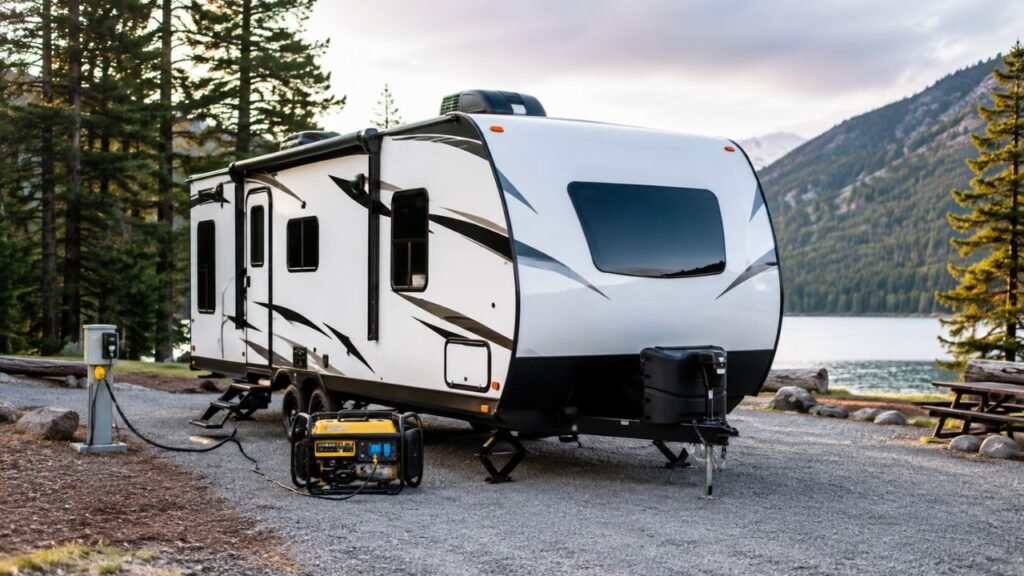
If your RV outlets work on shore power but not on a generator, check the generator-mounted breaker, generator output, power cord, surge protector, and automatic transfer switch. Because shore power works normally, the problem is usually somewhere along the generator’s separate power path.
I’ll help you follow that path from the generator to your RV outlets. We’ll begin with simple resets before moving toward transfer-switch and wiring checks.
Key Takeaways
- Reset the breaker mounted directly on the generator.
- Confirm the generator is producing stable 120-volt AC power.
- Check how generator power connects to your specific RV.
- Read any surge protector or energy management system error codes.
- Inspect the automatic transfer switch if shore power works normally.
- Reset the RV’s main breaker, outlet breaker, and GFCI outlets.
- Remove heavy loads before testing generator power again.
- Stop immediately if you find melted wiring or burning smells.
Why RV Outlets Work on Shore Power but Not Generator Power
Shore power and generator power do not always follow the same route into your RV. They may share the main breaker panel and outlet circuits, but each source has its own connection points before reaching that panel.
Shore power usually enters through the exterior inlet and power cord. A built-in generator normally enters through separate wiring connected to an automatic transfer switch.
That means your outlets can work perfectly on shore power while the generator side remains disconnected.
The fault is commonly caused by:
- A tripped generator-mounted breaker
- No usable electrical output from the generator
- A disconnected manual generator receptacle
- A faulty adapter or power cord
- A surge protector rejecting generator power
- A failed automatic transfer switch
- Loose or burned generator wiring
- An overloaded or undersized generator
The converter is usually not responsible for this particular problem. Your converter uses incoming 120-volt power to charge batteries and operate 12-volt equipment.
It does not normally create power for your standard RV outlets.
Follow the Generator Power Path First
Troubleshooting becomes much easier when you follow electricity in the same order it should travel. This helps you locate the exact point where generator power disappears.
Built-In RV Generator Power Path
A typical built-in generator system follows this route:
- Generator engine and electrical section
- Generator-mounted circuit breaker
- Generator output wiring
- Automatic transfer switch
- Surge protector or energy management system
- RV main circuit breaker
- Individual branch circuit breakers
- GFCI outlets and standard receptacles
If shore power works, the fault is often within the first five points.
Portable Generator Power Path
A portable generator usually follows a slightly different route:
- Generator electrical output
- Generator receptacle and breaker
- RV adapter or power cord
- RV shore-power inlet
- Surge protector
- RV main breaker panel
- Outlet branch circuits
- GFCI and standard outlets
Most portable generators power the RV through its normal shore-power inlet. They may not use the generator side of the automatic transfer switch.
This distinction matters because troubleshooting the transfer switch would be unnecessary in that setup.
Quick Generator-Power Troubleshooting Table
The symptoms you notice can point you toward the failed part. Use this table to decide where to begin checking.
| What You Notice | Most Likely Problem Area | What to Check First |
| Generator runs, but no AC appliances work | Generator output or breaker | Reset the breaker on the generator |
| Generator powers tools but not the RV | Cord, adapter, inlet, or transfer system | Test the complete RV connection |
| Power starts and then shuts off | Overload or unstable generator output | Turn off major appliances |
| Air conditioner works, but outlets remain dead | Branch breaker or GFCI | Reset outlet breaker and GFCIs |
| Shore power works, but built-in generator never transfers | Automatic transfer switch | Listen for the transfer relay |
| Surge protector rejects generator power | Voltage, frequency, neutral, or ground issue | Read the displayed error code |
| Generator runs but produces no voltage | Internal generator fault | Check its breaker, fuse, and output |
| Only half of a 50-amp RV works | One missing hot leg | Check breakers, wiring, and transfer contacts |
| Power changes when moving a cable | Loose or damaged connection | Stop using the system and inspect it |
Start With the Generator-Mounted Circuit Breaker
The first thing I would check is the breaker located directly on the generator. This breaker operates separately from the breakers inside your RV.
A generator breaker may trip after an overload or appliance startup surge. The generator engine can continue running even though it is no longer sending electricity.
Turn off the air conditioner, microwave, water heater, and other heavy appliances. Then locate the generator breaker and reset it properly.
Push the breaker fully to the off position first. After that, switch it firmly back to the on position.
Look for these possible warning signs:
- The breaker handle sits between on and off.
- The breaker immediately trips after resetting.
- One side of a double breaker remains tripped.
- The breaker housing feels unusually warm.
- Plastic around the breaker looks discolored.
- Power fails when an air conditioner starts.
Do not continue resetting a breaker that trips repeatedly. That usually means there is an overload, short circuit, weak breaker, or generator-output problem.
Confirm the Generator Is Producing AC Power
A running generator engine does not automatically mean electricity is available. You need to confirm that the generator is actually producing usable AC power.
Test a Portable Generator Receptacle
For a portable generator, plug a basic outlet tester into its receptacle. You can also use a properly rated multimeter if you know how to use one safely.
The reading should normally be close to 120 volts for a standard receptacle. A small variation is normal, but extremely low, high, or unstable voltage is not.
You can also plug in a simple appliance, such as a lamp. Avoid using expensive electronics as your first test load.
If the lamp does not work, check:
- The generator’s output breaker
- A GFCI receptacle on the generator
- Economy or power-saving mode
- Generator warning lights
- Overload indicators
- Internal electrical fuses
- Fuel quality and engine stability
A generator may run without producing electricity because of a failed voltage regulator, lost excitation, damaged winding, or internal control problem.
Test a Built-In Generator Output
Built-in generators are often connected through hardwired cables. Testing their output may require opening a generator compartment or transfer-switch enclosure.
This is where troubleshooting becomes more dangerous.
A qualified person can test whether voltage leaves the generator and reaches the transfer switch. This separates a generator failure from a transfer-switch failure.
The basic diagnostic logic is simple:
- No voltage leaving the generator points toward the generator.
- Voltage leaves the generator but never reaches the switch, indicating wiring trouble.
- Voltage reaches the switch but does not leave it, suggesting switch failure.
Do not touch exposed terminals while the generator is running.
Check Voltage Under Load
Some generators appear normal without a load but fail after appliances turn on.
Watch what happens when the converter, refrigerator, microwave, or air conditioner begins drawing power.
Possible signs of weak output include:
- Lights dimming severely
- Generator engine surging
- Breaker tripping during startup
- Surge protector disconnecting
- Appliances repeatedly restarting
- Voltage dropping under load
- Generator overload light appearing
Turn off every major appliance and test the outlets again. Add one load at a time after power returns.
Check the Generator’s Control Fuses
Some built-in generators contain control, excitation, startup, or field-related fuses. A failed fuse can sometimes allow the engine to run while preventing proper electrical output.
Fuse names and locations vary between generator models. Check the diagram inside the access panel or consult the generator manual.
Replace a blown fuse only with the same type and amperage.
Never install a larger fuse because the original fuse keeps blowing. A repeatedly blown fuse means another electrical problem is still present.
Determine How Your Generator Connects to the RV
Not every RV receives generator power in the same way. Before opening anything, identify whether your system uses an automatic switch, manual receptacle, or normal shore-power inlet.
Automatic Transfer Switch
Many motorhomes and larger fifth wheels use an automatic transfer switch. This switch chooses between shore power and generator power.
When the generator starts, the switch waits for stable voltage. It then moves the RV from shore power to generator power.
If the generator side of the switch fails, shore power may still work normally.
Manual Generator Receptacle
Some RVs have a receptacle inside the shore-cord storage compartment. You must plug the RV’s shore-power cord into this receptacle when using the onboard generator.
This setup does not transfer power automatically.
It is easy to forget this step, especially after staying at a campground. The generator can run perfectly while the unplugged RV receives nothing.
Check the cord compartment before assuming anything has failed.
Portable Generator Through the Shore Inlet
A portable generator generally connects through your RV’s normal shore-power cord and inlet.
In this arrangement, inspect:
- The generator receptacle
- Generator breaker
- Dogbone adapter
- Extension or generator cord
- Twist-lock connection
- RV power inlet
- Portable surge protector
An adapter only changes the plug configuration. It does not increase how much power the generator can supply.
Check the Automatic Transfer Switch
If you have a built-in generator, the automatic transfer switch becomes one of the most likely failure points. This is especially true when shore power continues working normally.
Listen for the Transfer Relay
Start the generator with major appliances turned off. Then listen near the transfer-switch location.
You may hear a noticeable click after several seconds. That click is the relay or contactor changing to generator power.
The delay allows generator voltage and frequency to stabilize.
No click can indicate:
- No generator voltage reaching the switch
- A failed relay coil
- A damaged sensing circuit
- A stuck contactor
- A loose neutral connection
- Burned generator-side contacts
- A failed transfer control board
Some transfer switches are quiet, so the absence of a click is not absolute proof. It is simply a helpful clue.
Test the Input and Output
A technician can test three important points:
- Generator output
- Generator input at the transfer switch
- Transfer-switch output toward the main panel
The test results make the diagnosis clearer.
Voltage at the generator input but no voltage at the output usually indicates a transfer-switch problem.
No voltage at the generator input points toward the generator or its wiring.
Correct output from the switch moves the investigation toward the main breaker panel.
Inspect for Loose or Burned Connections
Switch off shore power, the generator, the inverter, and all other power sources before opening the transfer-switch enclosure.
Look for:
- Burned insulation
- Melted terminal blocks
- Loose terminal screws
- Darkened copper conductors
- Corrosion
- Cracked relay components
- Burned electrical smells
- Signs of overheating
- Buzzing or chattering during operation
RV vibration can loosen electrical terminals over time. A loose connection creates resistance, and resistance creates heat.
Do not simply tighten badly burned wiring and continue using it. Heat-damaged terminals and conductors may require replacement.
Check the Surge Protector or Energy Management System
Your RV’s protection equipment may accept shore power but reject generator power. The generator can be running while the protection system intentionally blocks it.
Read the Error Code
Do not reset the surge protector before reading its display or indicator lights.
It may report:
- Low voltage
- High voltage
- Open neutral
- Open ground
- Reversed polarity
- Incorrect frequency
- Floating neutral
- Unstable generator output
- Missing hot leg
- Startup delay
Write down the exact error before making changes. The code may immediately reveal why power is being rejected.
Allow Enough Warm-Up Time
Many automatic transfer switches and electrical management systems include a delay.
The generator may need to run for several seconds before power reaches the RV. Some systems wait longer to protect air-conditioning compressors.
Start the generator with large appliances turned off. Allow it to stabilize before checking the outlets.
Do not repeatedly switch the generator on and off during this delay.
Do Not Bypass the Protection System
A surge protector may seem like an inconvenience when it blocks generator power. However, it may be protecting your refrigerator, converter, air conditioner, and electronics from damaging voltage.
Bypassing it without finding the cause can create a more expensive problem.
Diagnose the reported fault instead of ignoring it.
Could a Floating Neutral Block Generator Power?
Many portable inverter generators use a floating neutral. In this design, the neutral conductor is not bonded to the generator frame in the same way as some other power sources.
Certain RV surge protectors or energy management systems interpret this as an open-ground condition. They may refuse to connect generator power.
A neutral-ground bonding plug may solve the compatibility issue in some approved setups. However, it is not correct for every generator or RV.
Check the generator manufacturer’s instructions before using one.
Never create a permanent neutral-ground bond inside the RV. Incorrect bonding can allow current to travel along grounding conductors and metal components.
When the required bonding arrangement is unclear, consult a qualified technician.
Inspect the Generator Cord, Adapter, Plug, and RV Inlet
Every plug, adapter, and cord creates another possible failure point. These connections should remain tight, clean, and free from heat damage.
Check the Generator Receptacle
Inspect the generator outlet for:
- Cracked plastic
- Burn marks
- Loose contact pressure
- Corrosion
- Dirt or moisture
- A tripped GFCI
- Worn receptacle slots
- Incorrect receptacle selection
A worn receptacle may provide voltage without maintaining a secure connection under load.
Check the RV Adapter
Dogbone adapters are useful, but damaged or undersized adapters can overheat.
Look for discolored blades, melted plastic, loose molded ends, or a burning smell. Replace the adapter if any of these signs appear.
Remember that a 30-amp adapter does not turn a small generator into a 30-amp source.
Your available power remains limited by the generator’s actual output.
Check the Power Cord and Inlet
Inspect your RV power cord from end to end.
- Fully insert and lock twist-lock connectors.
- Check plug blades for pitting or discoloration.
- Look for cuts, crushed areas, or exposed conductors.
- Feel for loose movement inside molded plug ends.
- Check the RV inlet for heat damage.
- Confirm the inlet is firmly mounted.
- Replace damaged cords rather than taping them.
A connection can look secure while one conductor remains loose internally.
Reset the RV Main and Outlet Circuit Breakers
Although shore power works, it is still worth resetting the RV breakers after starting the generator.
Breakers do not always look tripped. The handle may remain close to the on position.
Follow this process:
- Turn off the generator.
- Switch off major appliances.
- Push the RV main breaker fully off.
- Reset every AC branch breaker.
- Restart the generator.
- Allow the transfer delay to finish.
- Turn the main breaker back on.
- Add appliances one at a time.
Pay special attention to breakers labeled receptacles, outlets, general, kitchen, bathroom, or inverter.
The automotive-style blade fuses beside the breakers normally protect 12-volt equipment. They generally do not supply power to your standard 120-volt outlets.
Reset Every GFCI Outlet
One tripped GFCI can disable several ordinary-looking outlets. The tripped outlet may be located far from the dead receptacle.
Check these common GFCI locations:
- Bathroom
- Kitchen
- Outdoor kitchen
- Exterior wall
- Wet bay
- Basement storage
- Near the refrigerator
- Under cabinets
- Near a bathroom sink
Press the test button and then press reset firmly.
A GFCI that refuses to reset may not be receiving incoming power. That points toward an upstream breaker, transfer switch, or generator issue.
If the GFCI resets but trips again immediately, disconnect appliances from the protected circuit. A faulty appliance, moisture problem, or downstream wiring fault may be present.
Check Whether Other 120-Volt Appliances Work
The behavior of other appliances can quickly narrow the problem. Determine whether all AC power is missing or only the outlets are affected.
Nothing Powered by 120 Volts Works
If the microwave, air conditioner, converter, and outlets are all dead, the problem is probably upstream of the branch circuits.
Check:
- Generator output
- Generator-mounted breaker
- Manual power-cord connection
- Surge protector
- Transfer switch
- Main breaker
- Main feeder wiring
This symptom usually does not point toward a single failed outlet.
The Air Conditioner Works but Outlets Do Not
If the air conditioner runs from the generator, power has reached the RV’s main panel.
The remaining problem is more likely related to:
- The receptacle circuit breaker
- A tripped GFCI
- Loose outlet wiring
- A failed receptacle
- Inverter pass-through wiring
- A disconnected branch circuit
In this situation, the generator and transfer switch are probably functioning.
Only One Side of a 50-Amp RV Works
A 50-amp RV receives two separate 120-volt hot legs. Losing one leg can disable several outlets and appliances while others continue working.
Possible causes include:
- One generator breaker pole tripped
- One failed transfer-switch contact
- A loose hot conductor
- Damaged adapter wiring
- A burned cord terminal
- Energy management system failure
- Limited portable-generator adapter configuration
Most RV appliances still operate on 120 volts. The two hot legs simply distribute more total power through the RV.
Check for Generator Overload
Your generator may be unable to support every appliance running at once. An overload can trip its breaker or cause voltage to collapse.
Turn Off High-Draw Appliances
Before restarting the generator, switch off:
- Air conditioner
- Electric water heater
- Microwave
- Electric fireplace
- Space heater
- Hair dryer
- Induction cooktop
- Washer or dryer
- Residential refrigerator
- Battery charger or converter
- Engine block heater
Start the generator with these loads off. Wait for stable power, then add one appliance at a time.
If power disappears after one particular appliance starts, that appliance may be overloading the generator or developing a fault.
Account for Air-Conditioner Starting Surge
An air conditioner uses significantly more power for a moment when its compressor starts.
A generator may handle the running wattage but still trip during startup.
Starting capacity may also decrease because of:
- High elevation
- Extremely hot weather
- Poor fuel delivery
- Dirty air filter
- Economy mode
- Weak engine performance
- Low propane pressure
- Generator maintenance problems
A soft-start device can sometimes reduce air-conditioner starting demand. It will not correct a faulty or unstable generator.
Check Fuel Quality and Engine Stability
The generator engine must maintain steady speed to produce stable voltage and frequency. Poor engine performance can create poor electrical output.
Inspect the Fuel Supply
Check for:
- Low fuel level
- Old gasoline
- Closed fuel valve
- Restricted fuel filter
- Dirty carburetor
- Low propane pressure
- Empty propane cylinder
- Contaminated diesel fuel
- Air trapped in a diesel fuel system
Some built-in generators shut down when the RV fuel tank reaches approximately one-quarter full. This prevents the generator from emptying the vehicle’s main fuel tank.
The exact shutdown level varies by RV design.
Watch for Surging or Hunting
A generator that repeatedly speeds up and slows down is not producing stable power.
This surging can cause the surge protector to disconnect the RV. The outlets may work briefly, stop, and then return.
Do not blame the surge protector without correcting the engine problem. It may be responding correctly to unsafe voltage or frequency.
Is the Converter or Inverter Responsible?
Converters and inverters are often confused with each other. Their role depends on how your RV electrical system is designed.
Converter Function
The converter takes incoming 120-volt AC power and changes it into 12-volt DC power. It also charges the house batteries in most RVs.
A failed converter may cause:
- Batteries not charging
- Dim 12-volt lights
- Weak water-pump operation
- Furnace control problems
- Low battery voltage
It normally does not prevent generator power from reaching every standard outlet.
However, a damaged converter can overload or trip the generator circuit. You can temporarily switch off the converter breaker during testing.
Inverter Function
An inverter changes battery power into 120-volt AC power.
Some inverter/chargers include an internal transfer relay. Incoming shore or generator power passes through this relay before reaching selected outlets.
A failed inverter pass-through relay can leave certain outlets dead even though other AC appliances work.
Check the inverter for:
- Overload warnings
- Fault codes
- Disabled pass-through
- Standby settings
- Low battery shutdown
- Tripped inverter breaker
- Internal transfer-relay failure
Only outlets wired through the inverter would normally be affected.
What Each Test Result Means
Once you complete the basic checks, use the results to identify the next area. This prevents replacing parts without confirming the failure.
| Test Result | What It Usually Suggests | Check Next |
| No voltage at generator output | Generator electrical problem | Breaker, fuse, regulator, or windings |
| Voltage leaves generator but never reaches ATS | Wiring or connection failure | Generator cable and terminals |
| Voltage enters ATS but does not leave | Transfer-switch failure | Relay, sensing board, or contacts |
| Voltage leaves ATS but not main panel | Feeder wiring failure | Cable and panel connections |
| Voltage reaches main panel but outlets remain dead | Branch-circuit problem | Breaker, GFCI, and outlet wiring |
| EMS reports open neutral or ground | Wiring or compatibility issue | Neutral, grounding, and bonding setup |
| Power fails only when appliances start | Overload or weak generator output | Generator capacity and appliance load |
| Only one 50-amp leg works | Open hot leg | Breaker, cord, ATS, or terminal |
| Power changes when wiring moves | Loose electrical connection | Stop use and arrange professional repair |
Safe Troubleshooting Order
Use this order so you begin with the easiest and safest checks.
- Disconnect the RV from shore power.
- Turn off major appliances.
- Confirm the generator has enough fuel.
- Start the generator.
- Allow the generator to stabilize.
- Reset the generator-mounted breaker.
- Test the generator receptacle or output.
- Check the manual generator connection.
- Inspect the adapter and power cord.
- Read surge protector error codes.
- Listen for the automatic transfer switch.
- Reset the RV main and branch breakers.
- Reset every GFCI outlet.
- Add appliances one at a time.
- Arrange professional testing if power remains unavailable.
Avoid jumping directly into the transfer-switch enclosure. Most generator-power problems should first be narrowed down using external checks.
Electrical Safety Before Opening Any Panel
Generator and transfer-switch systems contain dangerous 120-volt power. Some larger RV systems also contain two energized hot legs.
Follow these precautions:
- Disconnect shore power completely.
- Turn off and disable the generator.
- Disable the inverter.
- Disconnect batteries when required.
- Verify circuits are dead with a meter.
- Never assume an ATS enclosure is safe.
- Avoid touching exposed terminals.
- Do not tighten live connections.
- Remove jewelry before electrical work.
- Use properly insulated tools.
- Keep the work area dry.
- Replace heat-damaged components.
Remember that an inverter can continue producing AC power after shore power and the generator are turned off.
Solar panels may also continue charging batteries during daylight. Follow the shutdown procedure for your specific equipment.
When Should You Call an RV Technician?
Simple breaker, cord, GFCI, and connection checks are reasonable for most RV owners. Live testing inside generators and transfer switches requires greater electrical knowledge.
Call a qualified RV technician or electrician when you notice:
- Burning smells
- Melted plastic
- Blackened wires
- Buzzing transfer equipment
- Visible electrical arcing
- Repeated breaker trips
- Unstable generator voltage
- Missing neutral connections
- One dead 50-amp leg
- No electrical output from the generator
- Intermittent power when cables move
- Unclear neutral-ground bonding requirements
A technician can safely test voltage at each stage and find where the power path ends.
This is usually faster and safer than replacing a generator, surge protector, or transfer switch without confirming the fault.
How to Prevent Generator-Power Problems
Regular generator use and inspection can prevent many failures.
- Exercise the generator according to its maintenance schedule.
- Run a moderate load during exercise cycles.
- Keep gasoline fresh.
- Maintain propane regulators and fuel filters.
- Inspect cords and adapters regularly.
- Replace overheated plugs immediately.
- Keep transfer-switch compartments dry.
- Start the generator with major appliances off.
- Add large electrical loads gradually.
- Record electrical management system error codes.
- Service repeated surging or voltage problems.
- Inspect de-energized terminals during scheduled maintenance.
Generators often develop fuel and electrical problems when they remain unused for long periods.
Regular operation helps circulate fuel, dry internal moisture, and reveal developing problems before your next trip.
Final Answer
When RV outlets work on shore power but not generator power, begin with the breaker mounted directly on the generator. Then confirm generator output and inspect the cord, adapter, surge protector, transfer switch, main breaker, and GFCI circuits.
Because shore power operates the outlets normally, widespread outlet wiring failure is less likely. Stop troubleshooting if you discover unstable voltage, burned wiring, melted terminals, or transfer-switch damage.
Related FAQs
Why Does My Generator Run but Not Power My RV?
The generator may have a tripped output breaker, no electrical output, a disconnected manual power cord, an overload, rejected power from the surge protector, or a failed automatic transfer switch.
Where Is the Generator Breaker on an RV?
The generator breaker is commonly mounted on the generator housing behind its exterior access panel. Its exact position varies by generator model, so look for a small toggle or double-pole breaker near the controls.
How Long Should a Generator Run Before Power Reaches the RV?
Many automatic transfer systems wait several seconds before connecting generator power. Additional air-conditioner protection devices may delay compressor operation for several minutes after power reaches the RV.
Can an Automatic Transfer Switch Work on Shore Power but Fail on Generator Power?
Yes. The transfer switch uses different contacts and sensing components for shore and generator power, allowing the shore side to work while the generator side remains stuck, burned, or disconnected.
Why Does My Surge Protector Reject Generator Power?
The protector may detect low voltage, high voltage, unstable frequency, an open neutral, an open ground, reversed polarity, or a floating-neutral configuration that it considers unsafe.
Do I Need a Neutral-Ground Bonding Plug for My Generator?
Some portable generators and RV protection systems require a compatible bonding plug, while others do not. Always follow the generator and RV equipment manufacturers’ instructions before adding any neutral-ground bond.
Can a Bad Converter Stop RV Outlets From Working on Generator Power?
A converter usually affects battery charging and 12-volt equipment rather than standard AC outlets. However, a shorted or overloaded converter could trip the generator breaker when generator power connects.
Why Do Only Some RV Outlets Work on Generator Power?
A tripped branch breaker, GFCI outlet, loose receptacle connection, inverter pass-through fault, or missing 50-amp hot leg can leave only part of the outlet system without power.
Can an Overloaded Generator Stop RV Outlets From Working?
Yes. Excessive electrical demand can trip the generator breaker, reduce voltage, stall the engine, or cause the RV’s surge protection system to disconnect incoming power.
Should I Test an RV Transfer Switch Myself?
You may visually inspect it after disconnecting every power source, but live voltage testing should be performed only by someone trained to work safely around energized 120-volt electrical equipment.

David Marshall shares travel route insights, mileage planning tips, and road-tested advice. His writing helps travelers understand distance, timing, and equipment choices. Every article is built around clarity and real-world usefulness.