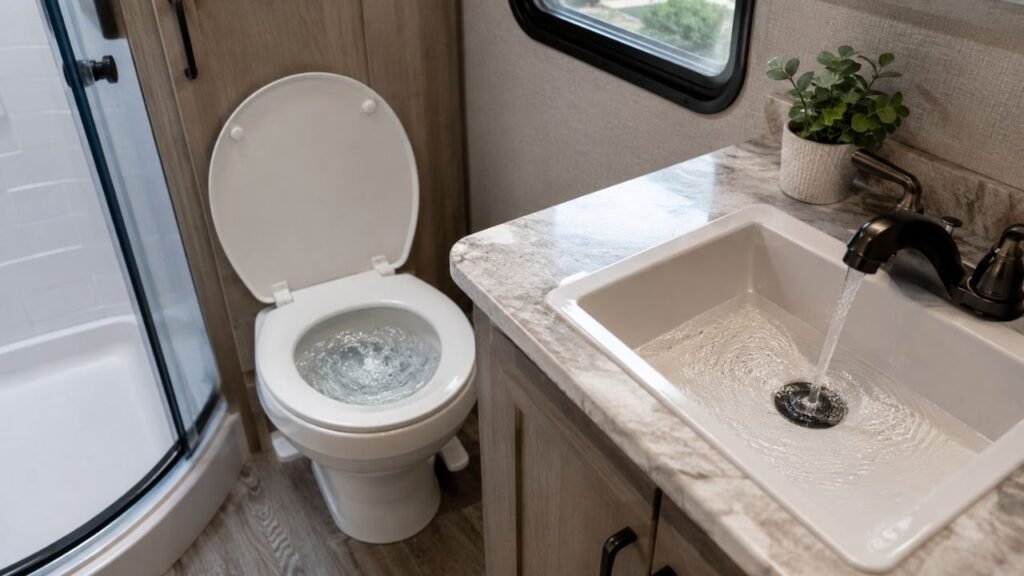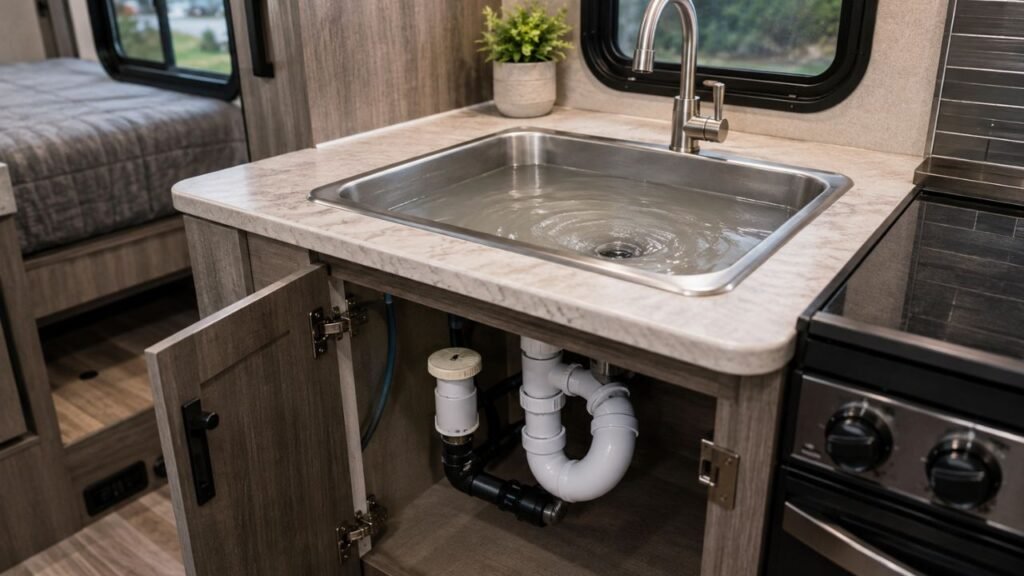
An RV sink can drain slowly even when the gray tank is empty because the problem may be inside the sink drain, P-trap, vent, or nearby plumbing. Common causes include grease buildup, trapped debris, a faulty air admittance valve, a blocked roof vent, or a poorly sloped drainpipe.
In this guide, I’ll help you narrow down the cause, check each part safely, and restore normal drainage without damaging your RV plumbing.
Key Takeaways
- An empty gray tank does not mean the drainpipe is clear.
- One slow sink usually points to a localized plumbing problem.
- Gurgling often indicates restricted airflow or a failing vent valve.
- Kitchen grease can slowly narrow small RV drainpipes.
- A clogged P-trap is often easy to clean yourself.
- Harsh household drain cleaners may damage RV plumbing components.
- A sagging or poorly sloped pipe can cause recurring slow drainage.
- Several slow fixtures may indicate a shared vent or main-line problem.
Why Can an RV Sink Drain Slowly With an Empty Gray Tank?
Your RV sink needs more than an empty holding tank to drain correctly. Water also needs a clear path through the plumbing and enough airflow behind it.
The Sink Drain Has a Localized Clog
When only one sink drains slowly, the blockage is usually close to that fixture. Food particles, hair, soap residue, toothpaste, and other debris can collect around the drain opening.
The blockage may not stop water completely. Instead, it narrows the opening and causes water to move slowly.
Dumping the gray tank will not clear this type of clog because the restriction sits before the tank.
The P-Trap Contains Debris
The P-trap is the curved plumbing section beneath the sink. It holds a small amount of water that prevents gray tank odors from entering your RV.
Unfortunately, that curved shape also catches debris.
Kitchen sink P-traps often collect grease, food scraps, coffee grounds, and soap residue. Bathroom sink traps may collect hair, toothpaste, shaving cream, and personal-care products.
Once this material builds up, water has less room to pass.
The Air Admittance Valve Is Stuck Closed
Many RV sinks have an air admittance valve, commonly called an AAV, beneath the countertop.
This small valve opens when water drains. It allows air into the plumbing so wastewater can flow toward the gray tank.
When the valve sticks closed, the draining water may create a vacuum. That vacuum slows the water and often causes gurgling.
The valve can also fail partly, which makes the problem appear and disappear.
The Roof Vent Is Blocked
Your gray water system may also use a vent pipe extending through the RV roof.
The vent allows air to move through the plumbing and releases tank gases outside. If leaves, insects, ice, or debris block the vent, drainage may become slow or noisy.
A roof vent problem often affects more than one fixture. You may notice slow drainage in both sinks or in the shower.
Grease Has Narrowed the Drainpipe
Cooking grease may enter the drain as a warm liquid. Once it cools, it begins sticking to the inside of the pipe.
Soap, food particles, and dirt then attach to that sticky layer. Over time, the usable opening becomes smaller.
RV drainpipes are usually compact and may have tight bends. Even a thin grease layer can noticeably reduce flow.
Soap and Mineral Deposits Have Built Up
Bathroom sinks may develop soap scum rather than cooking grease. Hard-water minerals can also coat the pipe walls.
These deposits rarely create a sudden blockage. Instead, drainage gradually becomes slower over several weeks or months.
You may clean visible debris and still have slow flow because the buildup continues farther inside the line.
The Drainpipe Has Poor Slope
RV plumbing normally relies on gravity. The pipe should slope downward from the sink toward the gray tank.
If the pipe is almost level, water may move very slowly. A loose support can also allow the pipe to sag and hold wastewater.
Some RVs leave the factory with minimal drain slope. Others develop slope problems after years of road vibration.
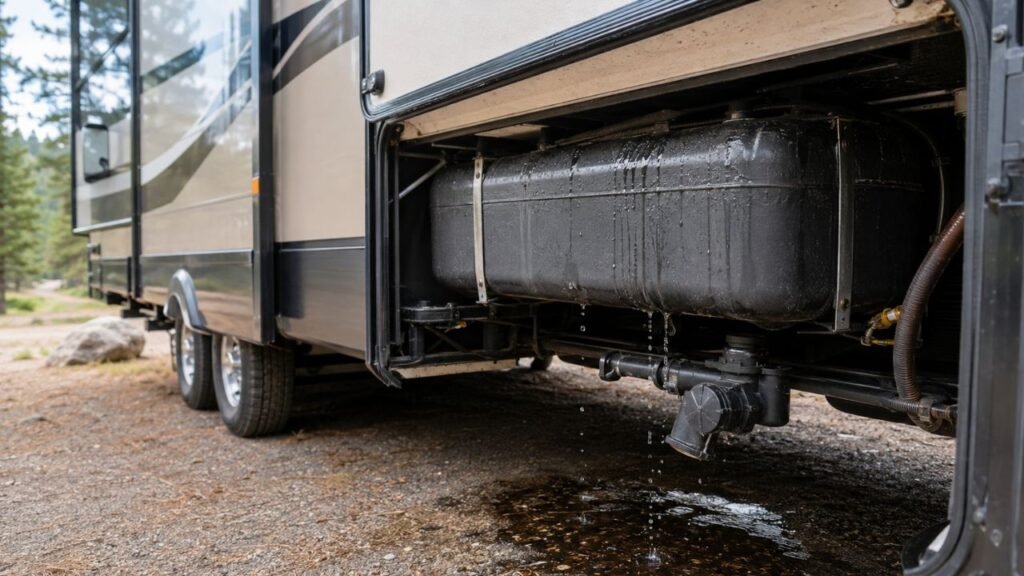
The Gray Tank May Not Be Completely Empty
Your monitor panel may show an empty tank while wastewater remains inside.
Soap residue can coat the tank sensors and cause inaccurate readings. The RV may also be parked at an angle that traps water away from the outlet.
A dump valve that does not open fully can create the same problem. The tank may release some water without emptying completely.
How Do I Identify What Is Slowing the RV Sink Drain?
Before removing pipes, compare the affected sink with your other fixtures. The pattern usually tells you where to begin looking.
| What You Notice | Most Likely Cause | What to Check First |
| Only one sink drains slowly | Local clog or P-trap blockage | Drain opening and P-trap |
| Sink drains slowly and gurgles | Faulty AAV or vent restriction | Air admittance valve |
| Both sinks drain slowly | Shared line or roof vent problem | Vent and common drainpipe |
| Sink and shower drain slowly | Tank, main line, or vent issue | Tank level and roof vent |
| Drain improves after trap cleaning | P-trap blockage | Reinstall and monitor |
| Drain improves when AAV is removed | Failed air admittance valve | Replace the AAV |
| Drain stays slow after cleaning | Poor slope or deeper buildup | Accessible drainpipe |
| Water backs up after dumping | Tank not fully empty | Dump valve and RV level |
| Slow drainage changes with RV position | Poor pipe or tank slope | Leveling and pipe support |
What Should I Check First?
Start with the easiest checks and move gradually toward harder areas. This approach helps you avoid taking apart plumbing that is working properly.
Confirm the Gray Tank Is Actually Empty
Open the gray tank dump valve and observe the flow.
A strong flow that quickly stops usually suggests the tank has emptied. A weak trickle may indicate a partially blocked valve, tank residue, or an unfavorable RV angle.
Make sure the RV is reasonably level. If possible, slightly adjust the RV so the tank outlet becomes the lowest point.
Do not rely only on the monitor panel. Tank sensors are useful, but they are not always accurate.
Compare Other Fixtures
Run water into another sink or the shower.
If the other fixtures drain normally, the problem is probably near the slow sink. Focus on its drain opening, P-trap, AAV, and nearby pipe.
If several fixtures drain slowly, look for a blocked roof vent, shared drain restriction, or tank problem.
Inspect the Drain Opening
Remove the sink stopper or strainer if possible.
Look for food particles, hair, soap, labels, or other debris. A small plastic drain-cleaning tool can help pull material from the opening.
Avoid pushing debris farther down with a screwdriver or rigid metal object.
Listen for Gurgling
Let the sink fill with a small amount of water, then release it.
A smooth but slow drain often points toward buildup. Repeated gurgling suggests the plumbing cannot pull in enough air.
A faulty AAV is especially likely when only one sink gurgles.
Check Beneath the Sink
Open the cabinet and inspect the visible plumbing.
Look for sagging pipes, loose supports, kinks, cracked fittings, or water stains. A horizontal pipe holding visible water may not have enough slope.
Also check whether the AAV is mounted vertically. These valves may not work correctly when installed sideways.
How Do I Clear a Clogged RV Sink P-Trap?
The P-trap is often the best place to start when only one sink drains slowly. It is usually accessible and may be cleaned without special equipment.
- Turn off the faucet and RV water pump.
- Place towels beneath the plumbing.
- Put a shallow bowl under the P-trap.
- Take a picture before removing anything.
- Loosen the plastic slip nuts carefully.
- Lower the trap and empty its contents.
- Remove grease, hair, food, and sludge.
- Wash the trap using warm water and dish soap.
- Inspect the washers for cracks or distortion.
- Reinstall the trap in the same position.
- Tighten the fittings by hand.
- Run water and check for leaks.
Do not overtighten plastic fittings. Too much force can crack the nut, distort the washer, or damage the pipe.
Some RVs use compact traps or waterless membrane traps. If your plumbing does not look like a standard curved P-trap, check the component before dismantling it.
How Can I Clean Grease and Soap Buildup From an RV Drain?
Light buildup may respond to warm water and grease-cutting dish soap.
Run warm water into the sink, add a small amount of dish soap, and let it move through the pipe. Repeat the process if the water begins draining more freely.
Do not use boiling water. Excessive heat may soften plastic plumbing or damage seals.
A flexible plastic drain tool may help remove debris close to the drain. Use slow, gentle movements so you do not scratch or separate lightweight fittings.
You can also remove the P-trap and clean the nearby pipe manually. Mechanical cleaning is often more reliable than pouring mixtures into the drain.
Baking soda and vinegar may loosen light residue, but they will not remove a thick grease blockage. Heavy buildup usually needs direct cleaning or a flexible plumbing tool.
Never pour cooking oil or melted fat down the sink. Wipe greasy cookware with paper before washing it.
How Do I Check the Air Admittance Valve Under the Sink?
The air admittance valve is usually located above the P-trap. It often looks like a small plastic cap threaded onto a vertical pipe.
Signs the AAV May Be Faulty
- The sink drains slowly without a visible blockage.
- You hear gurgling while water drains.
- Drainage improves when the valve is removed briefly.
- An odor develops inside the sink cabinet.
- Other fixtures continue draining normally.
- The problem returns after cleaning the P-trap.
How to Inspect the Valve
First, confirm that the valve is upright. An AAV needs to remain vertical so its internal mechanism can open and close.
Check whether the valve is loose, cracked, or coated with residue. You can unscrew it carefully and inspect the threaded connection.
For a brief test, remove the valve and run a small amount of water. Keep a towel near the opening and avoid using other fixtures during the test.
If the sink drains much faster without the valve, the AAV is probably stuck closed.
Do not leave the plumbing open permanently. The valve helps prevent odors and gases from entering the RV.
When to Replace the Valve
Replace the AAV when it is cracked, stuck, leaking odor, or no longer allowing proper airflow.
Most threaded RV air admittance valves are inexpensive and simple to replace. Match the pipe size and thread style before buying a new one.
Wrap or seal the threads only as recommended for the replacement valve. Excess sealant can interfere with installation.
How Do I Check an RV Roof Vent for a Blockage?
A blocked roof vent becomes more likely when several fixtures drain slowly together. You may also hear gurgling from different drains.
- Park the RV on stable, level ground.
- Use safe roof-access equipment.
- Locate the plumbing vent cap.
- Check for leaves, nests, insects, mud, or ice.
- Inspect the cap for cracks or displacement.
- Remove only debris you can reach safely.
- Avoid forcing rigid tools into the vent.
- Do not pour large amounts of water blindly.
- Replace a damaged or missing vent cap.
Mud daubers and other insects can build nests inside vent openings. Leaves and roof sealant can also block airflow.
If the obstruction sits deep inside the vent pipe, a flexible inspection tool may be needed. Avoid aggressive probing because vent connections can separate inside walls.
Call an RV technician when the roof is unsafe, the vent pipe is damaged, or the blockage cannot be reached easily.
Can Poor Drainpipe Slope Make an RV Sink Drain Slowly?
Yes, poor slope can make an RV sink drain slowly even when every pipe is clear. Water may sit inside a level or sagging section instead of flowing toward the tank.
Signs of a Drainpipe Slope Problem
- The sink has always drained slower than other fixtures.
- The P-trap remains clean.
- Water sits inside a visible horizontal pipe.
- Drainage changes when the RV is leveled differently.
- The pipe droops between support points.
- The problem returns quickly after cleaning.
- You hear water moving long after using the sink.
How the Pipe Should Be Corrected
The drainpipe should slope gradually toward the gray tank. It should not rise, dip sharply, or form a low pocket.
A loose support bracket may be repositioned or replaced. Additional support can sometimes eliminate a sagging section.
Do not force a rigid pipe into a new position. Moving it aggressively may stress a fitting or create a hidden crack.
If the poor slope comes from the original factory layout, the pipe may need rerouting. That repair is better handled by an RV technician, especially when the plumbing runs through walls or the underbelly.
Could the Gray Tank Be Empty but the Monitor Be Wrong?
RV tank sensors frequently become coated with soap scum, grease, and minerals.
This coating can make the monitor display the wrong level. A panel may show empty while the tank still contains water, or it may show full after dumping.
Watch the wastewater flow while dumping. That observation often tells you more than the monitor panel.
Also confirm that the valve handle moves through its full range. A damaged cable or debris around the blade can prevent complete opening.
The RV’s position matters as well. Water may remain trapped on the opposite side of the tank when the outlet sits slightly higher.
An inaccurate monitor does not directly slow the sink. However, it can lead you to assume the tank is empty when it is not.
What Should I Avoid Putting Down an RV Sink Drain?
- Cooking oil
- Bacon grease
- Melted butter or fat
- Coffee grounds
- Rice and pasta
- Thick sauces
- Fibrous food scraps
- Eggshell pieces
- Paint or solvents
- Automotive fluids
- Paper towels
- Wipes
- Harsh drain cleaners
- Boiling water
RV drainpipes are smaller and lighter than many household systems. Materials that pass through a home sink may create trouble inside an RV.
Use a fine sink strainer and empty it into the trash. Scrape plates before washing them and wipe greasy pans first.
Are Chemical Drain Cleaners Safe for RV Plumbing?
Strong household drain cleaners are not the best first choice for an RV.
Caustic products may damage rubber seals, plastic fittings, tank components, and dump valve seals. They may also remain trapped inside the plumbing when the clog does not clear.
Chemical cleaners can make later repairs more dangerous. A technician may open a trap without knowing that a strong chemical is sitting inside.
Begin with visible debris removal, P-trap cleaning, warm water, and gentle mechanical cleaning.
When you use a commercial product, choose one labeled for RV plumbing and holding tanks. Follow the product instructions and your RV manufacturer’s guidance.
How Can I Prevent My RV Sink From Draining Slowly Again?
Preventing slow drainage is much easier than clearing a heavy blockage. A few simple habits can protect the sink, pipes, and gray tank.
- Use a fine sink strainer.
- Scrape dishes before washing them.
- Wipe greasy pans with paper.
- Never pour cooking oil into the drain.
- Flush the sink regularly with warm water.
- Clean the P-trap when drainage begins slowing.
- Inspect the AAV during routine maintenance.
- Check roof vent caps each season.
- Secure loose drainpipe supports.
- Keep the RV reasonably level.
- Clean the gray tank periodically.
- Repair small leaks quickly.
- Avoid excessive soap and thick cleaning products.
Pay attention to small changes in drainage speed. A minor restriction is easier to remove before it becomes a complete blockage.
When Should I Call an RV Technician?
Some slow-drain problems extend beyond a removable trap or replaceable vent valve.
- Several fixtures remain slow after dumping.
- The roof vent is inaccessible.
- Water leaks beneath cabinets or flooring.
- The pipe disappears behind finished panels.
- A drain line repeatedly separates.
- The plumbing slopes uphill.
- The gray tank appears damaged.
- Wastewater backs up after basic cleaning.
- You suspect a blockage inside the tank inlet.
- Repairs require cutting or rerouting pipes.
Do not ignore water stains, soft flooring, or moisture inside the underbelly. A slow drain may seem minor, but a leaking fitting can create expensive structural damage.
A technician can inspect hidden pipe routes, vent connections, and tank inlets without guessing.
A Simple Troubleshooting Order for a Slow RV Sink
Use this order so you can rule out simple problems before moving toward larger repairs.
- Confirm that the gray tank is empty.
- Test the other sinks and shower.
- Remove visible debris from the drain.
- Clean the P-trap.
- Inspect and test the AAV.
- Check accessible drainpipe slope.
- Inspect the roof vent.
- Verify that the dump valve opens fully.
- Investigate the shared drain line.
- Call a technician if drainage remains slow.
In many cases, you will find the problem within the first five steps.
Final Thoughts
An empty gray tank rules out only one possible cause. Your sink still depends on a clear P-trap, open drainpipe, working AAV, and proper venting.
Start with the drain opening and P-trap before moving toward the roof vent or hidden plumbing. In most cases, a careful step-by-step check will reveal the restriction without harsh chemicals or major repairs.
Related FAQs
Why Does My RV Sink Gurgle When It Drains?
An RV sink usually gurgles because the plumbing cannot pull in enough air. A faulty air admittance valve, blocked roof vent, or partial drain clog can cause this sound.
Can an Empty Gray Tank Still Cause a Sink Backup?
The gray tank may not be completely empty due to poor leveling, a partially opened dump valve, residue buildup, or an inaccurate monitor reading.
Why Is Only One RV Sink Draining Slowly?
When only one sink drains slowly, the problem is usually inside that sink’s drain opening, P-trap, air admittance valve, or nearby branch pipe.
Why Do Both RV Sinks Drain Slowly?
Two slow sinks may indicate a blocked roof vent, shared drainpipe restriction, gray tank inlet problem, or a tank that did not empty completely.
Can I Use a Plunger on an RV Sink?
You can try gentle plunging on a minor clog, but strong pressure may loosen lightweight fittings or force debris deeper into the plumbing.
Can I Pour Boiling Water Down an RV Sink?
Avoid boiling water because it may soften plastic pipes and damage seals. Warm or moderately hot water is safer for RV plumbing.
How Often Should I Clean an RV Sink P-Trap?
Clean the P-trap whenever drainage slows, odors develop, or visible debris collects. Frequent kitchen use may require more regular cleaning.
Can a Bad Air Admittance Valve Cause Sewer Odors?
Yes, a damaged or stuck AAV can allow odors into the cabinet. It may also restrict airflow and cause slow, noisy drainage.
Does an RV Sink Drain Directly Into the Gray Tank?
Most RV sinks drain into a gray water tank, although some RVs use separate gray tanks or unusual plumbing layouts.
Can an Unlevel RV Make the Sink Drain Slowly?
A severely unlevel RV can worsen drainage, especially when the pipes have minimal slope or the tank outlet sits above retained wastewater.

David Marshall shares travel route insights, mileage planning tips, and road-tested advice. His writing helps travelers understand distance, timing, and equipment choices. Every article is built around clarity and real-world usefulness.